By Shivam Pujara

On a slide, independent medical practices look like a perfect market. Thousands of buyers, no procurement committees, no 18-month health system sales cycle, and an owner who can say yes in a single meeting.
But in practice, most of the startups pitching them never get past a pilot.
I run a billing company that works inside independent practices, inside their own EHR and practice management systems. That means I am often in the office when a founder's sales email lands, when the demo gets scheduled, and when the pilot quietly dies three months later. I have watched AI scribes, prior auth tools, patient messaging platforms, and analytics dashboards go through this cycle. Usually, the product was fine. The problem is often that the founder misread how a small practice actually buys, adopts, and pays for things.
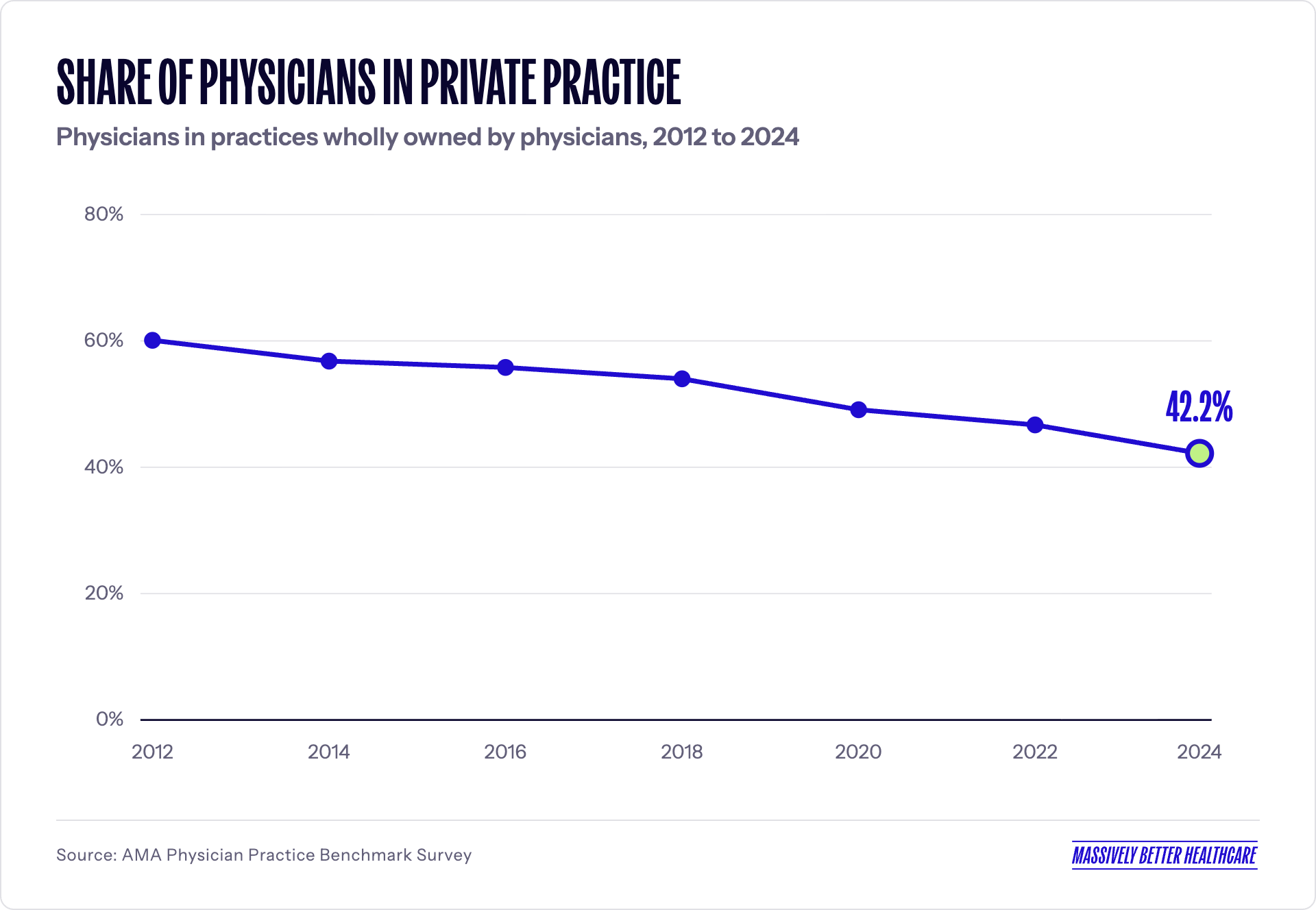
Selling to independent medical practices is getting harder and harder. The share of physicians working in private practice fell from 60.1% in 2012 to 42.2% in 2024, according to the AMA. By January 2026, the Physicians Advocacy Institute found that 82% of physicians were employed by hospitals or corporate entities. There are fewer independent buyers every year, and the ones left have very little slack.
Here is what I see founders get wrong, and what to do instead.
1. You're pitching the wrong buyer.
Founders love selling to doctors. Doctors are the name on the door, and they feel the pain most vividly. Plus, independent providers tend to be entrepreneurial and get excited by innovation.
Then the meeting ends with some version of "This sounds great, talk to Maria."
Maria is the practice manager or office manager. She runs the schedule, the front desk, the billing team, and every vendor contract in the building. She is also the person who will live with your product every day, pay the bills, train employees on using it, reach out when something breaks, and decide whether to renew the contract down the line. In most small practices, the physician holds the veto, but the practice manager is your real champion.
That changes the pitch. The physician wants to hear about outcomes and patient experience. The practice manager wants to know three things:
What does this take off my team's plate?
Who on my staff has to touch it, and for how long?
What happens on day one if something breaks?
A simple fix: in your first discovery call, ask who runs the front office and billing, and ask whether they can join the next meeting.
2. Your product competes for the scarcest thing in the practice: front-office time
Founders tend to think their competition is another startup. In an independent practice, your real competition is the phone.
When we surveyed 286 practice managers in March 2026, they estimated their teams spend 11 staff hours a week on insurance calls and portal checks. That is more than a full workday every week spent on hold or clicking through payer websites before anyone touches a new tool.
The team is also thin and turning over. In the same survey, 34% of practice managers said they had replaced a biller in the past two years, and open biller roles took a median 67 days to fill.
So when your onboarding plan says the practice just needs to spend "20 minutes a day" in your platform, the practice manager hears something different. She hears that she needs to find 20 minutes a day from a team that is already short a person.
The products that win here are designed for zero added clicks. They do the setup themselves, pull data from the systems the practice already uses, and show up inside existing workflows instead of asking staff to log in somewhere new. If your implementation plan has a long list of "practice responsibilities," shorten it until it fits on a sticky note.
3. You're asking them to switch, and switching is what they fear most
Rip-and-replace is a reasonable ask for a health system with an IT department. For a five-provider practice, it can be existential.
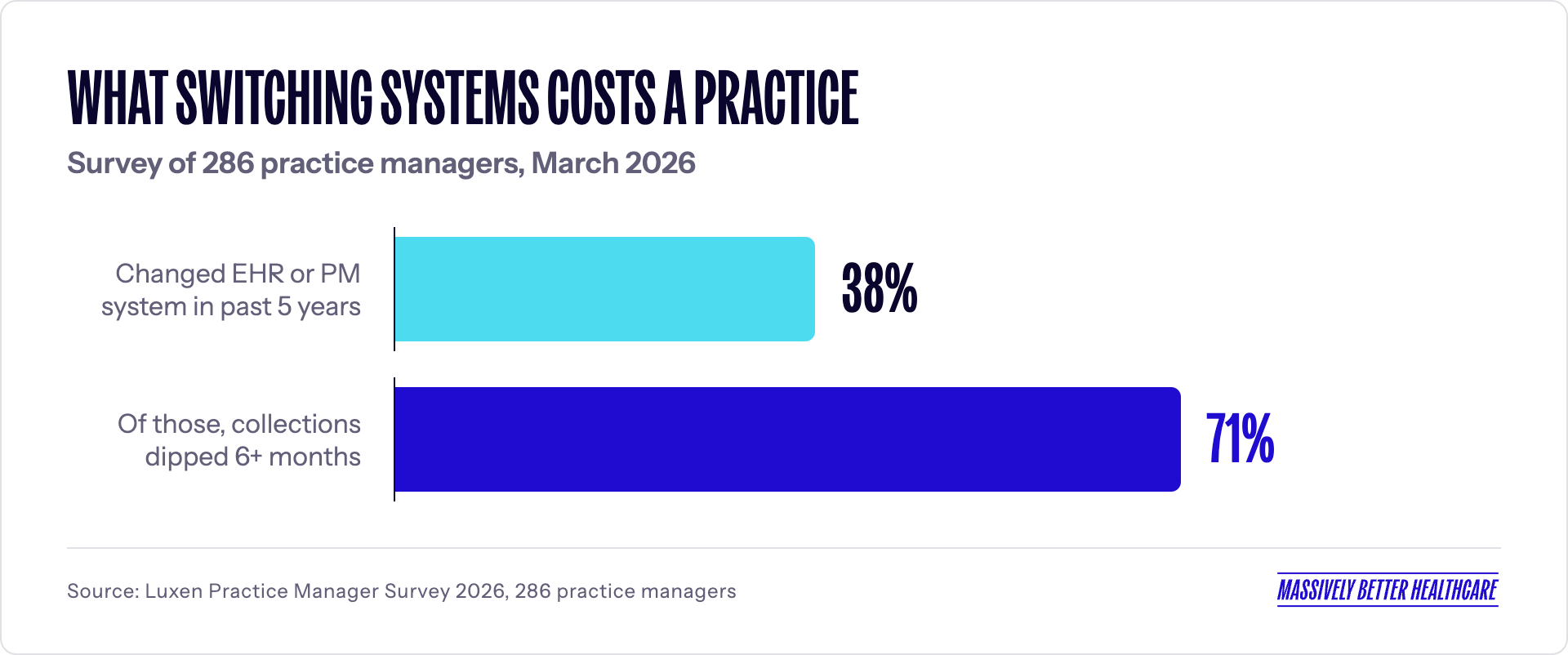
In our survey, 38% of practice managers said their practice had changed EHR or practice management systems in the past five years. Of those, 71% said collections dipped for at least six months after the switch.
Six months of lower collections at a small practice is not an inconvenience. It can mean missed payroll, a line of credit, or a conversation with a hospital about selling. Many of the practice managers you are pitching lived through that, and they remember it.
This is why a pitch built around "replace your current system" stalls even when your product is clearly better. Some practical alternatives:
Build on top of the system they already run rather than replacing it.
Offer a parallel run, where your product works alongside the old process until the numbers prove themselves.
Never make data migration a requirement in year one.
The less your product depends on the practice changing what it already does, the faster you will close.
4. Practices want the work done, not another point solution
A lot of products for practices are built to surface problems: a dashboard of denied claims, a list of patients overdue for follow-up, a queue of prior authorizations about to expire.
That is useful only if someone works the queue.
In our survey, 42% of practice managers said nobody on their team owns denial follow-up full time. In the 410 practice billing reviews we have done since January 2025, 19% of denied claims were never reworked or appealed at all. The problem in most small practices is not visibility. It is that there is nobody whose job it is to act on what the software shows them.
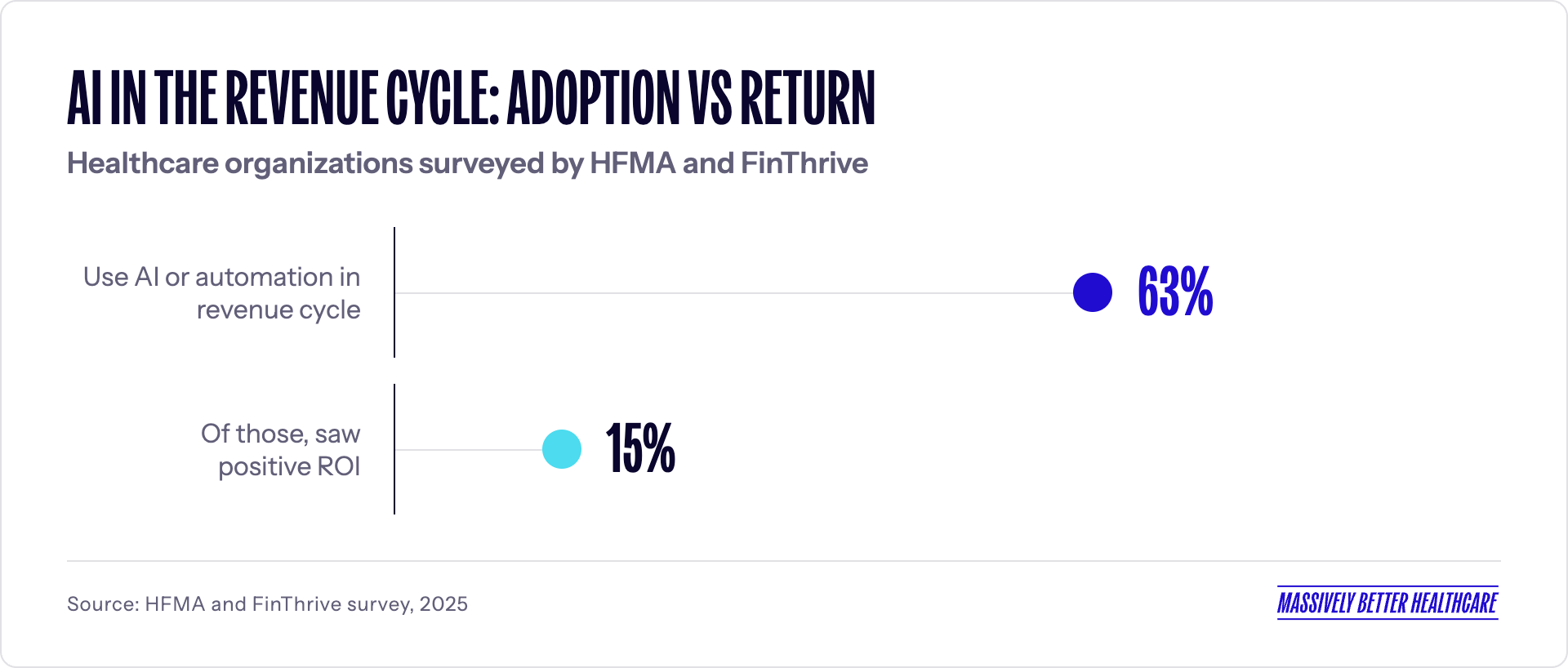
AI has not changed this as much as founders hope. An HFMA and FinThrive survey found that 63% of healthcare organizations use AI or automation in the revenue cycle, but only 15% had seen a positive ROI. Those are mostly health systems with full revenue cycle teams. A small practice has even less capacity to turn an alert into action. As we found, AI will not fix a revenue cycle that nobody works.
For founders, this is really a business model question. Do you sell software and hope the practice staffs it, or do you sell the outcome and bundle in the labor to get there? Many of the companies that have grown in this segment chose the second path, combining software with people who do the work. It is harder to scale and lowers your margins, but it matches what the buyer is actually trying to purchase: fewer problems, not more information about them.
5. Price around how the practice gets paid, not per seat
A practice does not think about its finances in seats or users. It thinks in collections: how much money actually arrived this month, and when.
Cash at a small practice is lumpy. A payer delays a batch of claims, a provider goes on leave, a credentialing application stalls, and suddenly the month looks very different. A flat per-provider fee that seemed small in the demo can feel heavy in a bad month.
Some of the most durable companies in this market are priced to match that reality. athenahealth, for example, built athenaOne on a percentage-of-collections model, so its revenue rises and falls with the practice's.
Zocdoc shows the other side. As Halle Tecco describes in her book, in 2019, Zocdoc moved New York providers from a flat annual fee of roughly $3,000 to a per-booking charge of $35 to $110 for each new patient. The logic was sound, since it lowered the barrier for smaller and rural practices. But physicians pushed back hard, in part because the fee still applied when patients did not show up. They were being charged for a unit they could not control.
The lesson is not that one model always wins. It is that practices respond best to pricing tied to something they can see and control—ideally, money arriving in their account.
Also, keep it simple. In our survey, 44% of practice managers could not name the fee basis in their current billing contract. Practice managers are not building spreadsheets to compare your pricing against alternatives. If your pricing cannot be explained in one sentence, it will be explained badly by someone else.
6. Your pilot has no baseline, so it can't prove anything
Pilots with independent practices tend to die in the same way. Nothing goes wrong. At day 60, everyone says it "seems fine." At renewal, nobody can point to a number that changed, so the practice manager cuts it to save money.
The root cause is usually that the practice never knew its starting point. In our survey, 63% of practice managers could not name their top three denial reasons. If a practice cannot say where it stands today, it cannot tell whether your product moved anything.
Founders can fix this themselves:
Pull the baseline in week one. Most practice management systems can export the reports you need. Do it for them rather than asking.
Agree on one metric. Not five. One number the practice manager cares about, such as days to get paid, denial rate, or no-show rate.
Name one owner on their side. Someone whose job includes checking in on the pilot.
Put the review date on the calendar before you start. Short pilots with a clear finish line convert far better than open-ended ones.
When the renewal conversation comes, you want to show the practice its own number, before and after.
7. The EHR is the gatekeeper, not an integration detail
Founders often treat EHR integration as a technical task to finish after the sale. For independent practices, the EHR is the sale.
A practice manager won't approve a tool their staff has to update by hand, and they will ask on the first call which system you work with. "We integrate with any EHR" usually reads as "we integrate with none of them well."
The better move is to pick the one or two systems where your target practices actually live, and go deep. Several ambulatory EHR vendors run marketplaces for third-party apps, and those marketplaces are real distribution channels. athenahealth says 71% of athenaOne customers use one or more Marketplace partner solutions. One partner's founder said of the program, "We wouldn't be where we are today without the Marketplace."
Being listed in the marketplace of the system a practice already trusts does two things for you at once. It removes the integration objection, and it borrows credibility from a vendor the practice manager already depends on every day.
Final thoughts
Independent practices are a real market, but they are a shrinking and stretched one. The practices that remain are run by small teams who have been burned by software that promised to save time and ended up costing it.
The founders who win here tend to do the same few things. They sell to the person who runs the office. They take work off her plate instead of adding to it. They fit into the systems and cash flow the practice already has. And they prove one number the practice can see for itself.
None of that is glamorous. But in a market where trust is earned one office at a time, it is what turns a pilot into a customer. And the opportunity goes beyond building a successful business. The right products can help independent practices become more efficient, compete with larger healthcare organizations, and ultimately stay independent.
Luxen's data in this article comes from a March 2026 survey of 286 practice managers and 410 practice billing reviews conducted between January 2025 and June 2026.