
How to Build a VC Target List (and Actually Get a Reply)
This is part of a series on fundraising:
How to Build a VC Target List (and Actually Get a Reply)
What to Look For in a VC Partner
Questions to ask in a VC meeting
Raising venture capital is a numbers game. Startup fundraising data from Docsend found that, at the seed stage, the average founder contacted 66 investors and had 38 investor meetings.
But more outreach doesn’t necessarily mean more money. They also found only a weak correlation between the number of investors contacted and the number of meetings held, and an even weaker correlation between the number of investors contacted and the amount of seed funding raised. Reaching out to the right VCs matters more than simply reaching out to more VCs.
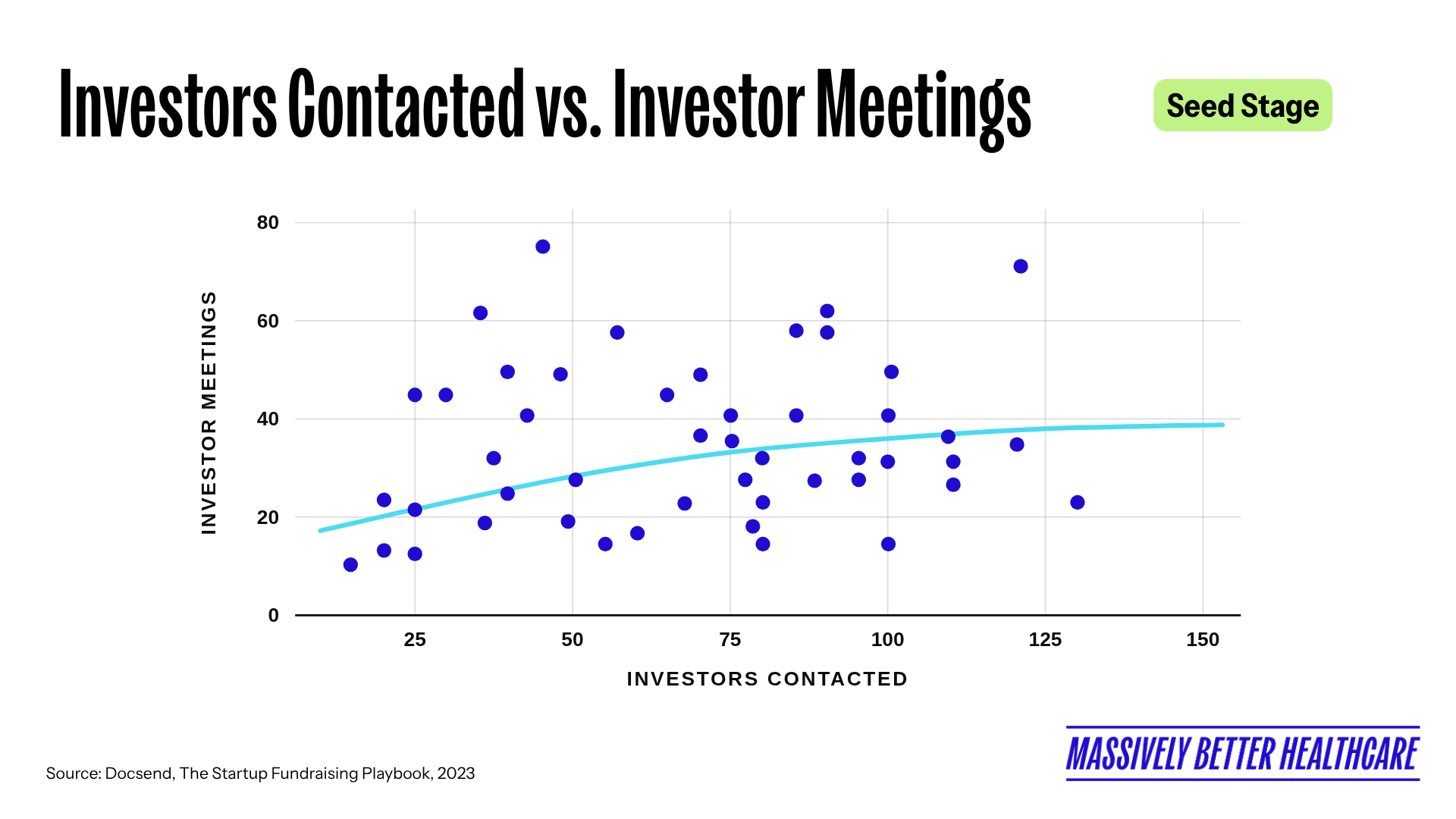
That’s why building a good target list matters. You need a large enough list to give yourself plenty of shots on goal, but a targeted enough list that those shots actually have a chance of going somewhere. The goal is twofold: to increase your chances of finding the right partner while avoiding time wasted on investors who were never a fit to begin with. In this piece, we’ll share our best practices for building that list and getting those investors to actually take the meeting.
Let’s jump right in.
The fundraising funnel in digital health
Fundraising is exhausting. Every hour spent chasing investors is an hour you're not spending building the product or supporting customers. So before you start, give investors as many reasons as possible to believe in the business. That means having real proof points:
Revenue or user growth
Clinical evidence
Signed contracts
Signs of product-market fit
Exceptional founder-market fit
Market tailwinds
Of course, you can't conjure up these proof points the week before a fundraise.
What you can control is how thoughtfully you build your investor list and how systematically you work through it. Finding the right partner can take dozens of conversations, and you can avoid conversations with investors that weren’t a fit to begin with.
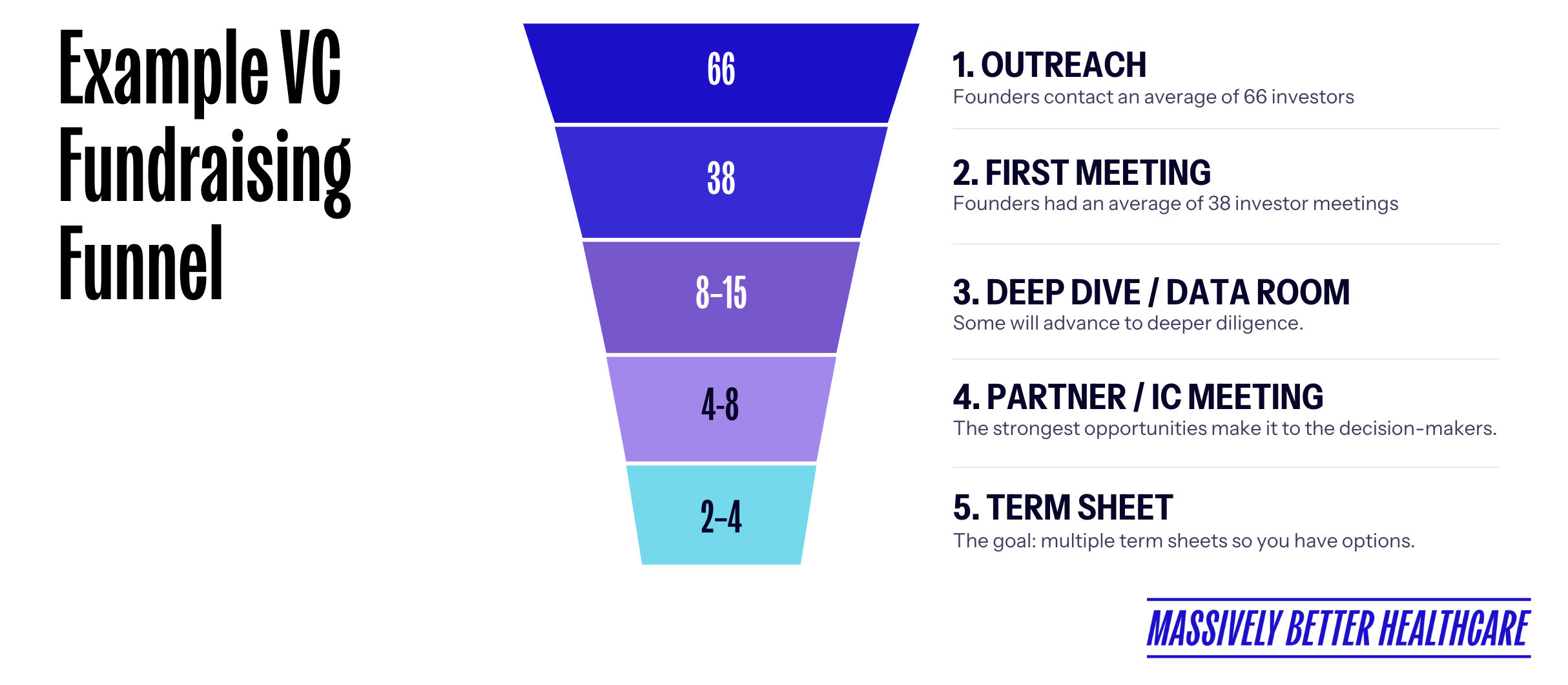
In digital health, a typical meeting-to-check conversion rate for a seed-stage startup is under 5%. The funnel below illustrates how quickly a broad investor list can narrow as conversations progress toward signed checks.
How to build your VC target list
Start with a spreadsheet. You’ll need the names of the funds you want to pitch to, but just as importantly, the specific person at each fund who might actually champion your company. We suggest aiming for 100 vetted investors to start.
A few ways to find them:
Start with investors you know
Ask people in your network if they have suggestions
Check out our Digital Health Investor Database to filter firms by investor type, fund size, stage, and focus. For a shorter starting list, Halle also recently published her picks for digital health VCs.
Look at the investor lists of adjacent (but not competitive) startups that have raised in the last 12 months
Use AI to find additional investors based on a non-confidential description of your company. Just double-check with the firm’s website since AI makes stuff up.
Your spreadsheet does not need to be complicated. At minimum, track the firm, the specific investor, typical check size, current fund, relevant portfolio companies, any connection you have, and where you are in the process. Here’s what that can look like:
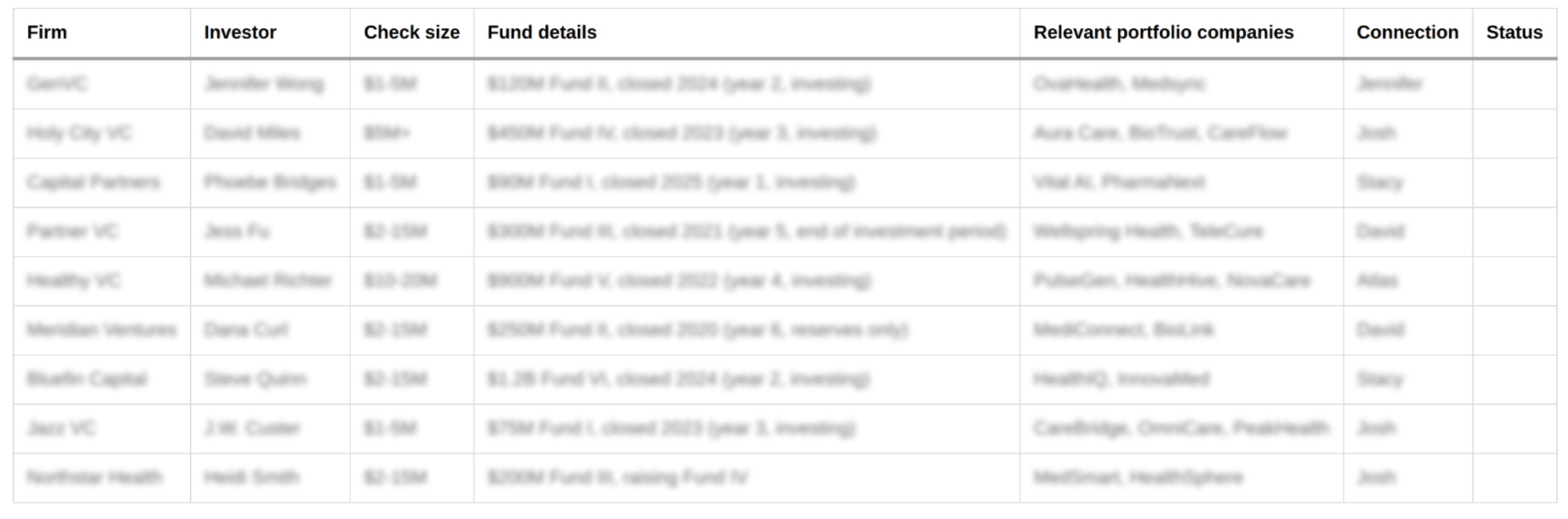
Once you have the raw list, start narrowing it down to your priority targets.
You’ll want to make sure they're still writing checks and not a “zombie” fund. CB Insights counted ~3,500 active US investors in Q1 2026, down from 5,600 at the Q1 2022 peak. Before spending time on outreach, check whether the fund has made recent investments and is still deploying capital.
Once you have the right firms, find the right person at each one. Associates and principals can absolutely source deals and become strong internal advocates, so don’t ignore them. But your target list should name the partner who actually covers your sector and stage and can champion your company internally. Pick one partner per firm, or at most two, rather than reaching out to the entire team.
Then look at the fund website. Check its typical check size, stage, and any published investment thesis or “call for startups.” There's no need to pitch an investor that only does growth if you're raising a seed round. It's also helpful to note the fund size next to the check size. Fund size changes a lot of the dynamics… which we get into in Part 2.
While you’re on the firm’s website, check out their portfolio page as well. I generally skip investors who have backed a direct competitor, though there are certainly VCs who invest in competing companies (at least a dozen have backed Anthropic and OpenAI). An adjacent company is a much better signal as they already understand the space, have demonstrated interest in it, and you won't spend the first meeting explaining the category.
Last, fill in the connection column with anyone who can help make the intro. Warm intros almost always beat cold, and the time to figure out who can make that introduction is now, not after you have already sent the email.
How to reach out to VCs
You’ve got your list, and now you can start working through it. Budget your calendar honestly. Carta estimates that the time from the first investor meeting to money in the bank typically takes three to six months. Start long before you need the money.
Get warm intros when possible
The highest-yield introduction comes from someone the investor knows and respects: a founder they have backed, a co-investor they trust, an angel they work with regularly, or a healthcare operator or executive whose judgment carries weight.
The person you’re asking to make the introduction is spending not only their time but also their credibility on your behalf. Treat the request accordingly and make it as easy as possible for them to help you.
Don’t assume your connection will introduce you on the spot; people will usually check with the investor first (a “double opt-in”) rather than introducing you cold to both sides. This slows things down, but it’s proper etiquette. It also gives the investor an easy way to decline, which is a courtesy you want extended to you when you are the one being asked.
Once your connection agrees to make the introduction, send a fresh, forwardable email with a few sentences the connector can pass along without editing:
What you do
The most impressive thing about your business, whether that’s the team, traction, or something else
Why this particular investor could be a fit
What you are raising
A link to the deck, or better yet, attach a PDF of the deck
Here’s an example:
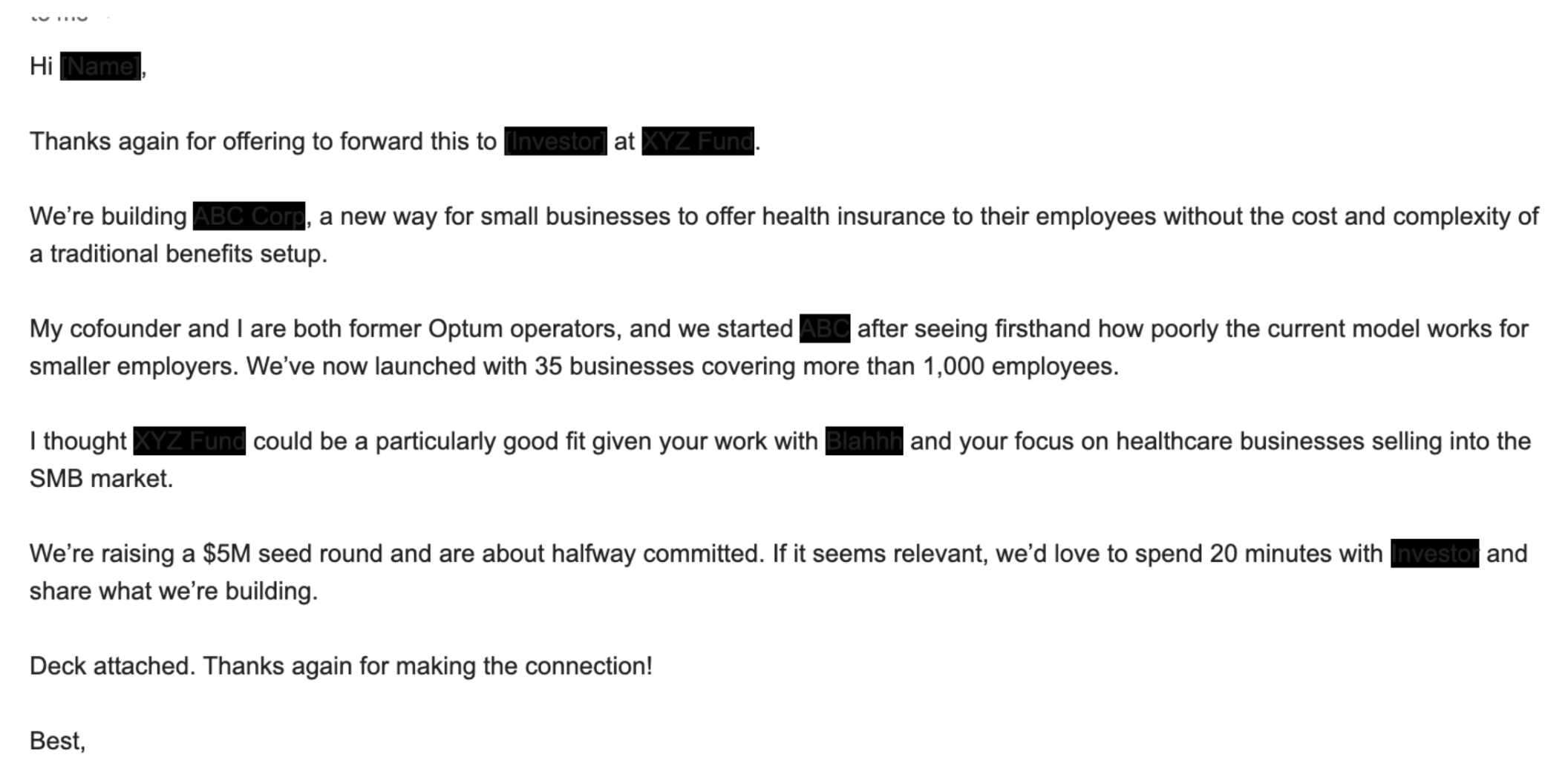
Finally, always close the loop. Thank the connector and update them on what happened. Most founders skip this, but it’s one of the simplest ways to make someone want to help you again!
How to nail the cold email
If you don't have a mutual connection, it's perfectly fine to reach out to a VC directly. While warm introductions can help establish credibility, cold outreach is far from futile. In a large field experiment, researchers sent more than 80,000 emails pitching fictitious startups to approximately 28,000 venture capitalists and angel investors. They found that more than 4% of individual pitches generated interested responses, with the strongest pitches performing substantially better, not surprisingly.
A targeted message that gives someone a compelling reason to engage can open the door. The goal isn't to tell your entire company's story or convince someone to write a check on the spot. It's to make the investor understand what you're building, why it might fit their interests, and why it's worth replying.
Here are seven ways to do that:
1. Make the subject line do some work.
Skip generic phrases like “Investment opportunity” or “Exciting startup.” Use the limited space to communicate your sector, stage, and strongest proof point. OpenVC recommends keeping subject lines under 60 characters, so an investor can read the whole thing on their phone.
For example, “AI prior auth | 14 health system pilots | Stanford alum” tells the recipient substantially more than “Revolutionizing healthcare.” The goal is to give someone with an overflowing inbox a reason to open your email.
2. Lead the email with what you do and why someone should care.
Your first sentence should explain the company in plain English. Your next should deliver the most compelling evidence that you're onto something. That might be revenue growth, customers, clinical validation, a distinctive founding team, or an insight you've earned by working in the industry.
Be specific. “We've signed six paying health systems” is stronger than “We're seeing incredible traction.” And don't bury the important information beneath a long account of how you came up with the idea.
Y Combinator's Michael Seibel recommends making the email readable in 60 seconds or less. If an investor needs to open your deck just to figure out what your company does, the email isn't doing its job.
3. Show that you did your homework.
Thoughtful outreach is more likely to get a thoughtful reply. You've already done the work of building a targeted investor list, so use it. In your email, reference a relevant investment or a specific area the investor has expressed interest in. Then connect that directly to your company.
The distinction is between a generic “I admire your impressive portfolio” and “You've invested in companies helping health systems automate administrative work, which is exactly the workflow we're addressing.”
This doesn’t need to be a paragraph of flattery. One well-researched sentence is enough. And if you can't explain why the investor is a fit, revisit the target list before sending.
4. Send it yourself.
Especially in the early stages, the email should come from the founder, ideally from a company email address rather than your Gmail.
Someone can help you research investors, organize the list, or proofread a draft. But don't hand the outreach process to an agency or have someone impersonate you. The investor is evaluating the person behind the company as much as the pitch. Show that you can articulate your own business and explain why you chose them.
5. Use AI to sharpen your thinking, not replace it.
AI can be useful for checking clarity, tightening a draft, and researching a fund. But don't let it write your pitch deck or outreach email.
Leslie Feinzaig of Graham & Walker has written about the sameness she sees in AI-generated pitches. Her point is that a compelling pitch needs to answer why this, why you, and why now. A beautiful deck or perfectly phrased email is no substitute for those answers.
Will Richardson of Giant Leap described one cold email that caught his attention. Its subject line was “Lame cold intro from the US.” The founder referred to specific portfolio companies, explained their personal reason for reaching out, and demonstrated familiarity with the firm's website. Richardson replied because the message was clearly written for him.
6. Make the next step easy.
A cold email needs one clear ask. Depending on the context, that might be asking whether the investor would be interested in learning more or proposing a brief introductory call. Don't ask for investment, advice, feedback, and introductions all at once.
Have a deck ready and include it as a link or PDF rather than making the investor reply just to request it. The email should make sense on its own, though. If the email doesn’t get them excited, they’re unlikely to open the deck.
7. Follow up thoughtfully, then move on.
A good email can get buried. If you haven't heard back, send one short follow-up after several business days. You don't need to rewrite the original pitch or apologize for following up.
Venture Capital Careers recommends one follow-up, then stopping unless you have a meaningful new development. A new customer, product milestone, or financing update can provide a genuine reason to reengage later. Repeatedly sending “just bumping this” can be annoying.
Best practices for reaching out on LinkedIn
Cold outreach doesn't have to happen over email. LinkedIn gives investors an immediate way to understand who you are, but you have even less space to make your case.
Chirag Shah of Define Ventures shared a simple rubric for the unsolicited founder messages that catch his attention: a highly credentialed founder, a company aligned with an investment thesis he's excited about, or compelling early traction. Lead with your strongest signal.
A few LinkedIn-specific considerations:
Make sure your profile establishes credibility. Your headline, company, and experience should make it easy for someone to understand who you are and what you're building.
Find a thoughtful way in. Avoid sending generic connection requests. Consider a personalized connection note, InMail, or an introduction through a mutual connection. You can also engage with an investor's posts before reaching out directly.
Keep it exceptionally short. A LinkedIn message should be even more concise than a cold email. Give the investor one reason you're reaching out and make the next step easy.
Keep the momentum going. If the investor responds, be ready to continue the conversation and schedule a call promptly.
Estelle Giraud, founder of Trellis Health, shared a cold LinkedIn message she sent to an investor she didn't know. We've redacted the investor's identifying information:

The investor replied seven minutes later and asked to schedule a call. Estelle sent her calendar link that evening, and they booked a meeting within 24 hours. That one outreach developed into a relationship with a core angel investor who ultimately invested more than $200,000 in Trellis's pre-seed round.
What made it work? Estelle demonstrated that she'd researched the recipient, succinctly described her company, and made a low-pressure request. When the investor responded, she kept the conversation moving.
Estelle also shared another tactic: leave a thoughtful, substantive comment on an investor's LinkedIn post, then follow up privately if they engage with it. That creates a natural opening for a conversation rather than an entirely unsolicited message.
Next up: what to look for in a VC
Getting the meeting is only the first filter. In Part II, we get into how to diligence the investor and the fund before you take their money, from who you will actually work with to fund size, follow-on behavior, and what happens when things go badly.
