Venture Capital Jobs, How Much They Pay, And How to Land Them

It’s ironic that I’m writing this because when I tried to get a job in venture capital (VC) in business school, no one would hire me. At the time, no fund was interested in a dedicated digital health hire, so I started Rock Health. I went from having zero VC experience to co-running a fund and learning everything along the way. Today, I’m a board partner at Giant Ventures. Proof, I suppose, that the long way around sometimes gets you further.
VC is a great job. It’s interesting and intellectually stimulating work, good pay, and you spread your risk across multiple companies. But most importantly, working with and supporting founders feels meaningful. You develop connections with visionaries seeking to change the world, and you get to play a role, however small, in bringing that change to fruition.
However, getting a job in VC is not easy. The industry is known for its exclusivity, opacity, and for having a fairly narrow aperture for entry. There’s no singular route into this industry. Most get their foot in the door through industry experience and simply knowing the right people.
If you're aspiring to work in venture capital, don't let the industry's exclusive reputation discourage you. Venture capital is the business of finding exceptional people and ideas before everyone else. The industry needs more people with different experiences, perspectives, and expertise because better pattern recognition comes from seeing the world through different lenses. Your unique background may be the very thing that helps you spot opportunities others miss.
Whether you're a new graduate, an industry veteran, or a career switcher, let's explore the diverse roles within a venture fund and how you might claim one as your own.
Below, I share common titles, responsibilities, and pay scales, but every fund (institutional or corporate) has a different structure.
How are VCs compensated?
VCs are paid through two main components: cash and carried interest, commonly called "carry."
Cash compensation is a salary plus, in some cases, a bonus, paid out regardless of how the fund's investments perform. It's the steady, predictable part of the job and, as you'll see below, it scales with seniority and fund size.
Carry is the variable, long-term upside. When a fund's investments are profitable, the outside investors who supplied the capital (called limited partners, or LPs) are paid back first. After they get their money back 1x, they also typically receive 80% of the profits. The remaining 20% is then divided among the fund's partners and team members based on their individual "carry points," or percentage interest in the pool, which usually correlates with seniority and tenure at the fund.
The catch is that many funds make no money at all. In fact, among funds started between 2000 and 2015, 53.3% had a DPI (distributions to paid-in capital) of less than 1x, meaning they made no carry. For funds that do make money, it takes a while (typically 7-10+ years). So while a junior team member might have a small carry allocation, and a GP a much larger one, nobody sees that money until (and only if) the fund's portfolio companies succeed and exit.
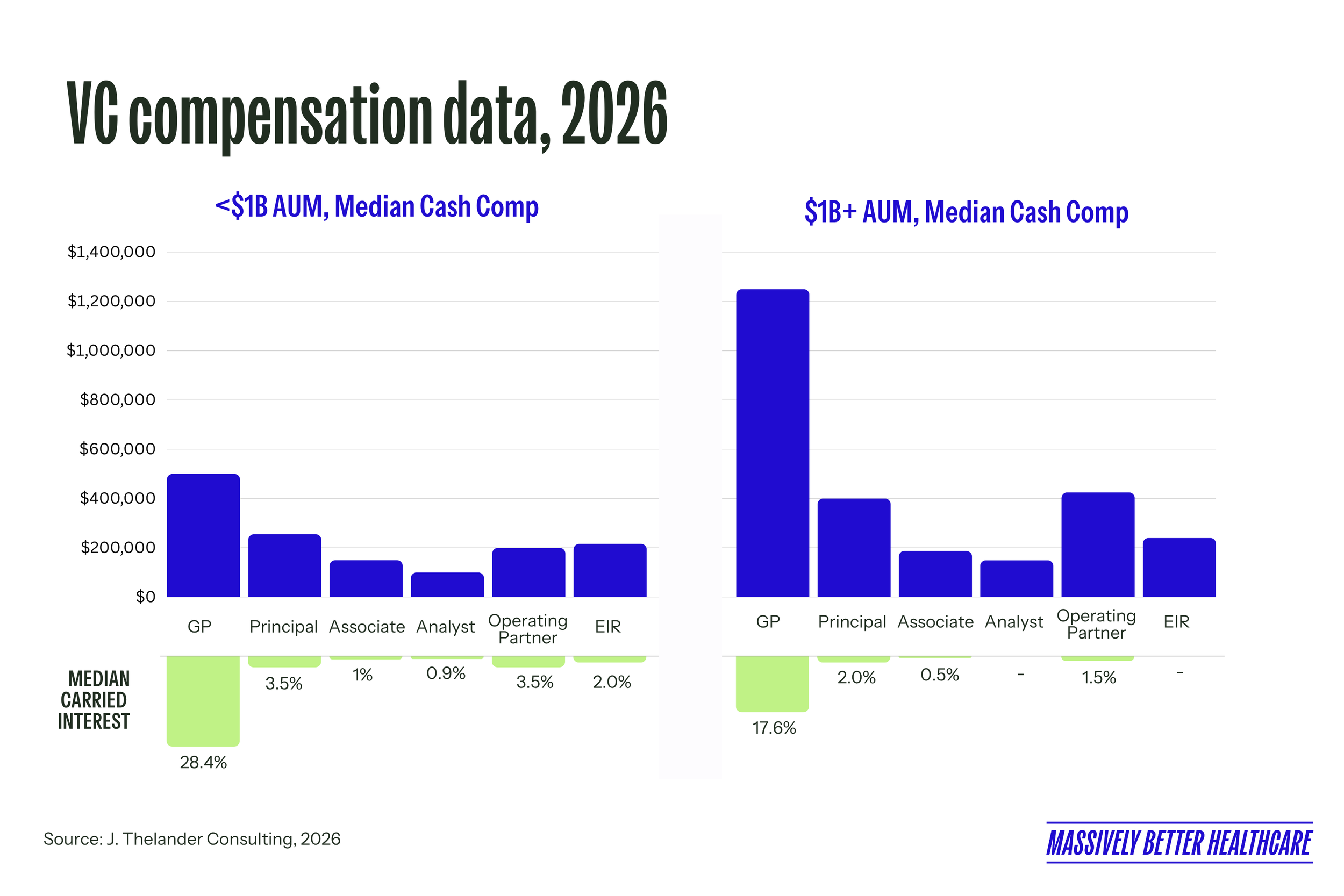
A quick note on how to read the numbers below: the "carried interest" percentages in the compensation data reflect each role's individual share of the fund's 20% carry pool, not a dollar figure. What that translates to in actual dollars depends entirely on how large the fund is and how well it performs.
With that, let’s dive into details for some of these roles.
General Partner (GP)
Arguably the most well-known role within a venture capital firm is the Partner, often broken down into Managing and Non-Managing Partners:
Managing Partners are often the founder(s) of the fund, they control the management company, lead fundraising of the fund itself, and make investment decisions.
Non-Managing Partners (who usually just go by GP) are partners in the fund but may not have control of the management company, but are still senior leaders in the fund.
GPs are the decision-makers, the strategists, and the brand representatives of the fund. They raise the fund, lead investment decisions, cultivate relationships with entrepreneurs, and are typically the ones with the most "skin in the game," both in terms of capital investment and personal reputation.
How much they make:
According to J.Thelander Consulting, the median cash compensation for a GP at a fund with under $1 billion in AUM (assets under management) is $500,000, but this can range based on the size and success of a fund. The 75th percentile is $763,940, and the max is $5 million. The median carry (short for "carried interest," the percentage of a fund's profits that are paid to the fund's managers) for a GP is 28.4% (the 75th percentile is 45% and the max is 90%).
For those with $1 billion or more AUM, the median pay is $1.25 million and the carried interest is $17.6%
How to get there:
Becoming a partner is usually the result of years of experience in the industry, with a successful track record as an investor (and a fundraiser!). Many partners also transition from entrepreneurial roles or leadership positions in relevant industries. They either start and raise their own funds or join an existing fund.
Limited Partner (LP)
Limited Partners (LPs) are the external investors who provide the capital that VC firms deploy. They can range from institutional investors like pension funds and university endowments to wealthy individuals and family offices. While LPs are not involved in the day-to-day operations or investment decisions of the fund, their influence can be significant, particularly when it comes to governance and the overall direction of the fund.
How much they make:
Unlike the other roles in a venture capital firm, Limited Partners (LPs) aren't employees. Their financial gain comes from returns on their investment in the fund itself.
LPs pay the GPs a management fee to run the fund and, in return, typically get the vast majority (~80%) of the returns when a portfolio company successfully exits (the GPs get the remaining ~20%).
How much an LP makes can vary significantly based on the fund's success. The range can go from losing capital if the investments underperform to earning multiple times the initial investment if the fund has a "home run" exit (or a few). According to Industry Ventures, the target IRR (aka internal rate of return, taking into account the time it takes to make the return) for a fund is 30% for early-stage investing and 20% for later-stage investing.
How to get there:
Becoming an LP isn't so much a career path as it is an investment decision. If you’re interested in becoming an LP, you’ll need to be an accredited investor, because investing in a venture capital fund is very high risk.
VCs are always raising capital, and the most direct route to becoming an LP is simply to reach out and express interest.
Venture Partner or Board Partner
Venture Partners differ from General Partners in that they often don’t have a long-term commitment to the fund and are usually not full-time employees. They are specialists brought in for their expertise in a specific domain or industry and are valuable for sourcing deals and advising portfolio companies. Some funds use the term “Board Partner” to indicate that the goal is for the venture partner to find deals, and ultimately serve on those boards.
How much they make:
According to Glassdoor, the median base salary for a Venture Partner is $362,000 per year. Keep in mind, Venture Partners are generally not full-time partners. They also get carry in the deals they bring into the fund, and sometimes in the entire fund as well.
How to get there:
Industry experts with a solid network and a proven record in a specific sector may be tapped for Venture Partner roles. Usually, Venture Partners have prior entrepreneurial or executive experience.
Operating Partner
Unlike partners who focus solely on deal-making or fund management, Operating Partners engage in the trenches, aiding startups in scaling operations, honing strategy, and sometimes even stepping into interim executive roles.
How much they make:
According to J.Thelander Consulting, the median total cash for an Operating Partner at a fund under $1 billion is $200,000 with 3.5% carry, rising to $425,000 and 1.5% carry at funds over $1 billion.
How to get there:
The journey to becoming an Operating Partner is less prescriptive than that of more traditional venture capital roles. Often, these individuals have already led a successful career in operations or executive leadership, accumulating hands-on experience in scaling businesses. They might hail from the C-suite of a successful startup, with a focus on operational and go-to-market excellence.
Principal (sometimes called Vice President or Director)
Principals usually act as a bridge between associates and partners. They have more authority in the decision-making process than associates, but are not yet making the final calls on investments. Their role may include:
Building relationships with entrepreneurs and other investors
Creating investment theses
Overseeing ongoing relationships with portfolio companies
Leading and negotiating deals
Managing relationships with portfolio companies
Principals often lead specific investment theses or sectors within the firm and are usually on track to either become partners in 3-5 years or move on.
How much they make:
According to J.Thelander Consulting, the median total cash for a Principal/Director at a fund under $1B is $255,000, with a median carry of 3.5%. At larger funds, that rises to $400,000 but carry drops to 2%.
How to get there:
The journey to Principal often involves first serving as an associate. Demonstrated success in deal sourcing, due diligence, and portfolio management are key progression metrics. In some cases, professionals join as Principals directly from senior operational roles in startups or other industries.
Associate
Associates play a huge role in any venture fund. What they do depends on the firm, but here are some typical tasks an Associate might take on:
Sourcing deals
Screening inbound deals
Maintaining databases of startups
Creating market landscapes and trendspotting
Supporting due diligence and writing investment memos
Supporting portfolio companies
The Associate's role is a mix of analytics and human judgment, often serving as the initial filter through which potential investments must pass.
How much they make:
According to J.Thelander Consulting, the median total cash for an Associate at a fund under $1B is ~$150,000, with carry around 1%. At funds over $1B, the median is $187,500 with 0.5% carry.
How to get there:
These jobs are often available both pre- and post-MBA. Having past experience in startups, investment banking, or consulting is helpful. Networking, particularly with current employees and alumni of VC firms, can often open doors to associate roles. But more often than not, these roles are posted online.
Analyst
The analyst role seems less common today than when I was starting out. This is generally a role for new graduates, and their responsibilities often include market research, financial modeling, and due diligence tasks. Analysts are sometimes expected to become experts in specific sectors or technologies, thereby aiding the firm in identifying trends and opportunities before they become apparent to the market at large.
How much they make:
According to J.Thelander Consulting, pre-MBA analyst total cash has a median of $100,000 and reaches $125,000 at the 75th percentile at smaller funds — and up to $150,000+ at larger ones.
How to get there:
To break into this role, candidates typically need a background in finance, economics, or a field related to the firm’s investment thesis (say, computer science or AI). These jobs can be listed online, or you can reach out to firms to express your interest in joining.
Entrepreneur-in-Residence (EIR)
EIRs are entrepreneurs who temporarily join a VC firm to develop a new startup idea or assist with company formation. The role is generally short-term, and they often leave the VC firm to launch their ventures or join one of the firm's portfolio companies.
How much they make:
According to J.Thelander Consulting, total cash for EIRs typically falls between $216,000 and $260,000 at smaller funds.
How to get there:
Having a track record as a successful founder and early employee is the standard pathway into an EIR role. EIRs generally have a sense of what they want to work on, but could benefit from some time and support to get it off the ground. Some VC firms also use the EIR position as a way to retain talent between ventures and get in early.
Advisor
Advisors offer strategic counsel to the VC firm or its portfolio companies on a part-time or project basis. Their input can range from providing sector-specific insights to supporting due diligence to bringing in deal flow.
How much they make:
I am an advisor to one fund and get a tiny amount of carry in exchange for my time. I also get to invest in the fund without any management fees.
How to get there:
Typically, senior executives, industry leaders, or even academics serve as Advisors. This role can also be a gateway to more substantial roles within the VC ecosystem, or just a way for them to have insight into innovation in their field.
Mentor
Mentors, although not formally a part of the VC firm, are seasoned entrepreneurs or industry experts who offer guidance to the portfolio companies. These roles are especially common at accelerators and early-stage funds. They help a VC differentiate by offering portfolio companies access to experts in the space.
How much they make:
These are usually unpaid roles, but mentors can get a small amount of carry in a fund.
How to get there:
If you have years of experience and a desire to give back, becoming a mentor can be as straightforward as reaching out to VC firms or startup accelerators and offering your services.
Intern
Internships serve as a gateway to jobs in many venture capital firms. These temporary roles, usually lasting for a few months in the summer (or part-time during the school year), offer a unique vantage point into the day-to-day operations of venture investing. Interns may be tasked with responsibilities ranging from market research and data analysis to supporting due diligence efforts and even assisting in portfolio management.
How much they make:
I’ve seen VC interns make between $25-40/hour with no carry. FOR-PROFIT VENTURE FUNDS WHO DO NOT PAY INTERNS ARE BREAKING THE LAW. Even if the internship is called a “fellowship”, don’t work for free. Not only is it illegal, but it’s also unethical.
How to get there:
Getting an internship often requires a mix of prior work experience, relevant coursework, and networking. However, VC firms are increasingly valuing diverse skill sets, so don't be discouraged if your background isn't strictly in finance or economics. Many firms appreciate interns who bring unique perspectives, whether from fields like engineering, social sciences, or even the arts.
Other (non-investing) roles
VCs rely on more than just the frontline investors. Especially as a fund grows, there are more operating roles that help a fund run smoothly. Some examples include:
Head of Platform makes sure that portfolio companies have access to all of the resources that a VC firm can provide from knowledge exchange to recruitment to fundraising.
CFO (Chief Financial Officer) is responsible for the financial health and governance of the firm. From managing fund accounting and compliance to overseeing financial strategy.
General Counsel oversees legal activites such as drafting term sheets and managing regulatory compliance.
Back-Office staff can include various roles in accounting, human resources, and office management. They handle tasks ranging from payroll and employee benefits to budget management.
Administrative Assistants are responsible for a myriad of tasks—calendar management, correspondence, and logistical arrangements—that enable the senior leadership to focus on strategic activities.
Investor Relations serves as the bridge between the VC firm and its Limited Partners. They are responsible for communications, performance reporting, and fostering relationships that are critical for capital raising and fund performance.
Other specialized roles can include IT support, data analysts, marketing professionals, and more. As venture capital firms grow in complexity, they may require specialized skills that don't fit neatly into traditional categories but are indispensable for the firm's success.
In terms of career entry points, these roles often require expertise in their respective fields, whether it be finance, law, or communications. The recruiting process may resemble those of other industries but may also demand an understanding of startups or venture capital.
So, if you are drawn to the world of venture capital but feel that investing roles aren't your forte, these non-investing, operating roles offer a meaningful way to contribute. They provide the framework within which the more visible aspects of venture capital—such as deal-making and portfolio management—can occur successfully. And for those who excel in these areas, the sky's the limit; your skills are the bedrock upon which great ventures are built.
Closing thoughts
I didn't get here by following a prescribed path, and neither do most people. The people I've seen break into this industry did it by being genuinely useful: to a founder, to a partner, to a portfolio company that needed someone who actually knew the domain. That's still the job, whatever the title.
You can access real-time cash and carry data on the Thelander platform by filling out the Thelander-PitchBook Investment Firm Compensation Survey here. There is no cost to participate, and all respondents receive access to the same data they give. All data is published in aggregate with no individual names or firm names reported.