Thank you to Carly Newhouse and Sofia Noori for feedback and edits as I developed this article! Disclaimer: I am an investor in Brightside Health, Clarity Pediatrics, Headway, and Marvin.

For seven consecutive years, mental health has attracted more venture capital than any other clinical area in digital health.
That’s billions of dollars poured into startups promising to make mental healthcare more accessible, affordable, and effective. We have therapy apps, online psychiatry practices, employee mental health benefits, and platforms that help therapists build their businesses. Now, artificial intelligence is creating another wave of opportunities.
But after all that investment, what do we have to show for it?
Some startups have built businesses worth billions of dollars (on paper). A few have gone public or exited. And others have struggled to find sustainable business models, shut down, or sold for less than investors once hoped. And despite meaningful progress in expanding access, millions of Americans still struggle to get mental healthcare. There’s much more work yet to be done.
How big is the mental health market?
The need is enormous.
1 in 5 U.S. adults live with a mental illness
1 in 7 Americans ages 12 and older has a substance use disorder
1 in 7 U.S. youth ages 6-17 experience a mental health disorder each year
1 in 20 U.S. adults experience serious mental illness each year
Mental healthcare accounts for a meaningful share of U.S. healthcare spending. A Health Affairs study found that spending on treatment for mental health and substance use disorders reached $139.6 billion in 2021, growing faster than the growth rate for overall medical services.
And demand for care continues to exceed the supply of clinicians. According to the federal Health Resources and Services Administration (HRSA), approximately 137 million Americans, or 40% of the population, live in a designated mental health professional shortage area.
For entrepreneurs, this creates myriad opportunities: helping more people find the right level of care in the right setting for the necessary amount of time, broadening the pool of clinicians who can treat mental health challenges at varying levels, reducing administrative burden, expanding measurement-based care to assess quality, and supporting and testing new interventions that don't require a traditional one-on-one appointment or weekly follow-up.
Venture funding of mental health startups
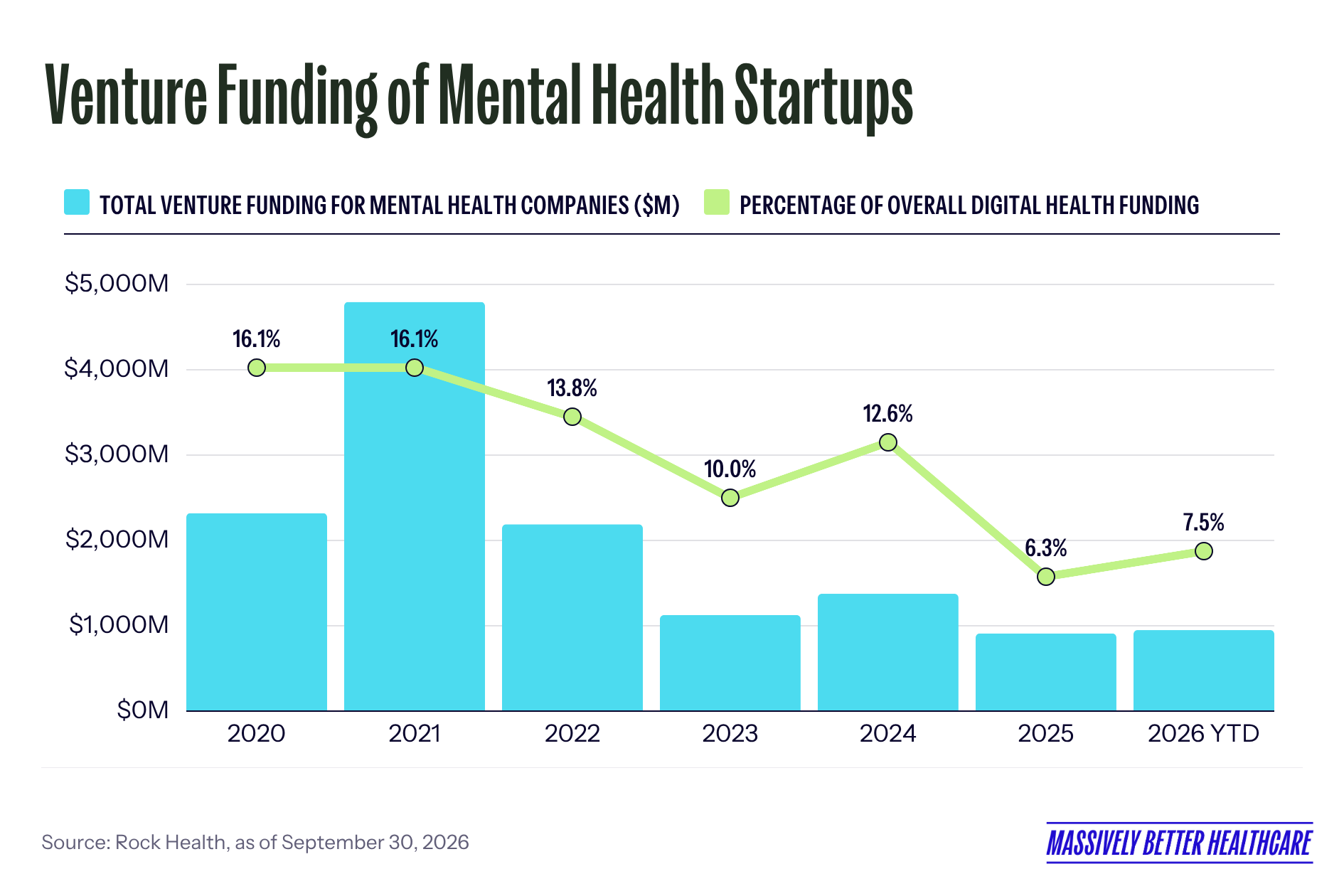
According to Rock Health, investors have poured nearly $14 billion into U.S. mental health startups since 2020, backing 419 companies spanning everything from virtual therapy platforms and digital therapeutics to specialized psychiatric care and mental wellness apps.
Funding peaked in 2021, when mental health startups raised nearly $4.8 billion, more than double the roughly $2.3 billion raised in 2020. Like the rest of digital health, the sector experienced a steep decline in venture funding following the pandemic-era boom. By 2025, annual funding had fallen below $1 billion, a drop of approximately 80% from the peak.
Even as mental health remains the most heavily funded clinical area, its share of overall digital health investment has been shrinking. In 2020 and 2021, mental health startups captured 16.1% of all digital health venture funding. Today, it’s half that.
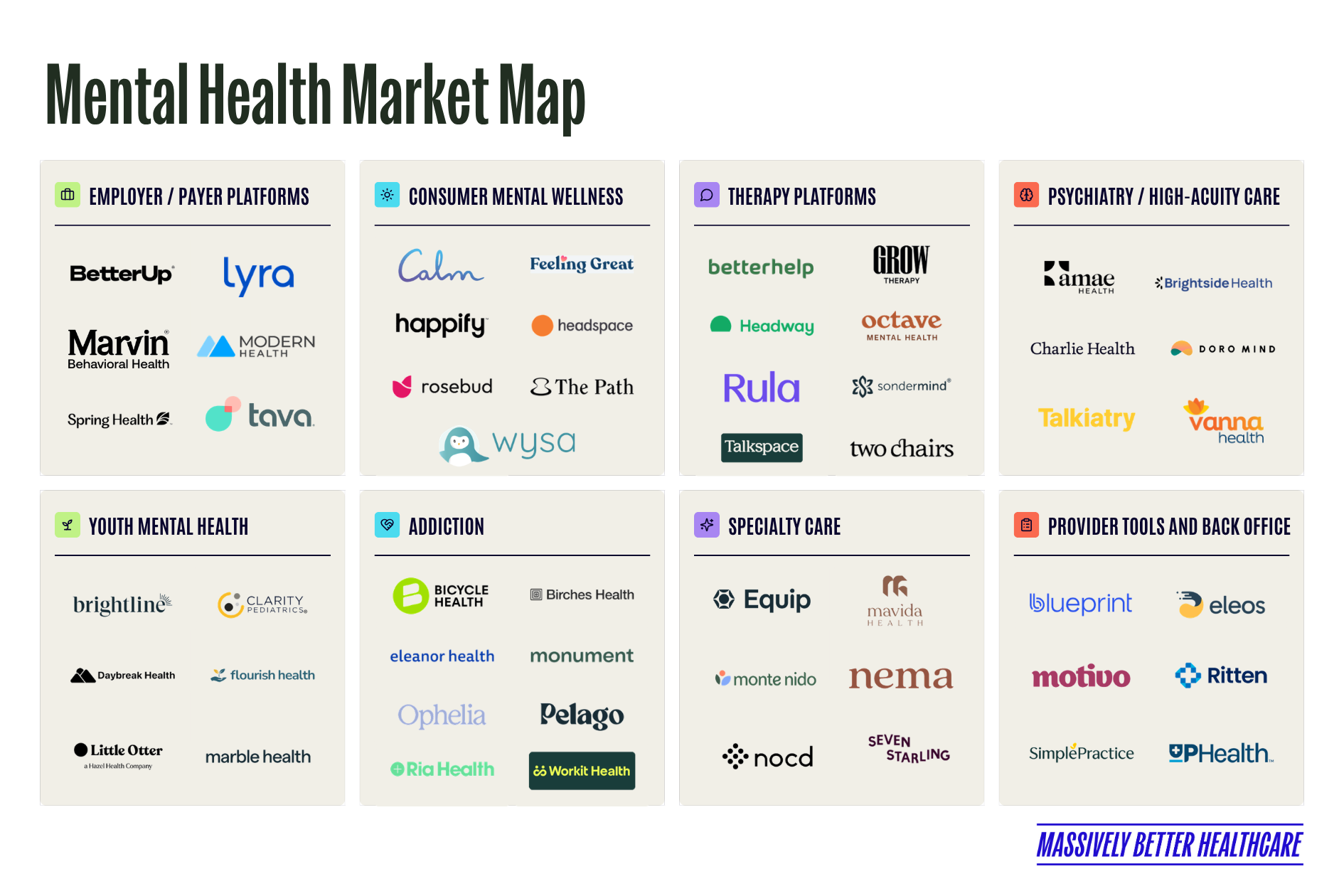
Because this market is so large, it helps to break it down into different corners of mental health across virtual, in-person, and hybrid care. This is not a comprehensive list!
The biggest exits in mental health startups
For all the venture funding poured into mental health, up until this point, we haven’t seen a ton of profitable exits.
LifeStance Health may be the biggest commercial success story to date. Founded and backed by growth equity firm Summit Partners in 2017, LifeStance Health quickly scaled and went public in 2021 at a $7.5 billion valuation. Although it currently trades below its IPO valuation, it is one of the 20 largest digital health companies by market cap. As of writing this, the company expects $1.725 billion in revenue this year, is net profitable, and has a $5 billion market cap.
Talkspace is a complicated success story. The online therapy startup is an OG in health tech, having been founded in 2012. It went public through a SPAC merger in 2021 at a $1.4 billion enterprise valuation, only to see its share price collapse with the market. The company then shifted from its original direct-to-consumer model toward insurance-funded mental healthcare. By 2025, it generated $229 million in annual revenue and had reached profitability. In August 2026, Universal Health Services acquired Talkspace for an enterprise value of about $835 million.
AbleTo pioneered virtual behavioral healthcare in 2008 and delivered care through partnerships with health insurers, long before telehealth became mainstream. In 2020, Optum acquired it for a reported $470 million. According to early investor .406 Ventures, AbleTo grew its revenue more than 50-fold and its valuation more than 100-fold between the firm's initial investment and the acquisition.
Headspace merged with virtual mental health provider Ginger in 2021, creating a company valued at $3 billion. In October 2026, Sword Health acquired Headspace in an all-cash deal reportedly worth $200 million to $300 million, which is unfortunate for investors who put in $320 million over the company’s history.
SilverCloud Health was founded in Ireland in 2012 and developed online cognitive behavioral therapy programs used by health systems and insurers. In 2021, Amwell acquired SilverCloud for approximately $226 million, including contingent consideration, after the startup had raised just over $30 million in venture funding.

While exits and large-scale M&A have been few and far between, there have been numerous fire sales and small or undisclosed exits, especially in the last year:
Cerebral acquired ADHD app Inflow for an undisclosed amount in 2026.
Spring Health acquired Alma for an undisclosed amount in 2026.
Grow Therapy acquired Tenor Therapy for an undisclosed amount in 2026.
NOCD acquired Rebound Health for an undisclosed amount in 2026.
WPS Health Services acquired Mavida Health in 2026.
Teladoc acquired UpLift for $30 million in 2025.
Cerebral acquired Resilience Lab for an undisclosed amount in 2025.
NeuroFlow acquired Quartet Health for an undisclosed amount in 2025.
Hazel Health acquired Little Otter for an undisclosed amount in 2025.
Lyra Health acquired Bend Health for an undisclosed amount in 2025.
SonderMind acquired Mindstrong’s technology in 2023, as Mindstrong wound down.
Teladoc also acquired BetterHelp for $3.3 million in 2015.
Has digital health actually improved mental healthcare?
After billions of dollars in investment, are Americans receiving better mental healthcare?
There are reasons to be optimistic.
Virtual care has undoubtedly made treatment more convenient and accessible. It has also expanded the geographic reach of clinicians and specialists into more rural areas (and other states, if the therapist complies with expensive and confusing state licensing laws).
According to the 2024 National Survey on Drug Use and Health, approximately 33.4 million American adults (12.8% of the adult population!) received mental health treatment via telehealth that year.
There's also meaningful clinical evidence supporting certain forms of digital mental healthcare:
A 2024 systematic review and meta-analysis of 54 randomized controlled trials involving 5,463 patients found virtual therapist-guided cognitive behavioral therapy as effective as in-person care.
A 2024 meta-analysis of 154 randomized controlled trials found that virtual cognitive behavioral therapy could produce lasting improvements in symptoms of anxiety, depression, PTSD, and other conditions.
A 2026 comparative effectiveness study of more than 813,000 Veterans Affairs patients found that video-based mental healthcare was associated with higher appointment completion rates and fewer psychiatric hospitalizations and emergency department visits.
A 2025 meta-analysis published in The Lancet Digital Health looked at 72 randomized controlled trials involving over 21,000 participants who used standalone smartphone mental health apps. It found beneficial effects for several conditions, including depression, anxiety, and sleep problems, but evidence was weaker or inconclusive for several other outcomes, including suicidal ideation and alcohol misuse.
This doesn't mean every startup delivering virtual mental healthcare delivers evidence-based, quality care. And access without quality doesn’t move the needle. That’s why investing in evidence (a concept I dedicate an entire chapter to in my book) is so important. It can be expensive and hard to prioritize early on when a company has limited resources, but those who fail to build evidence do so at their own peril, and that of their patients.
Encouragingly, more companies are making their clinical results public. Clarity Pediatrics recently published its clinical outcomes, Brightside Health continues to publish research, and Spring Health released a large outcomes study demonstrating measurable improvements in patients' mental health.
Has digital health at least made mental healthcare cheaper?
Digital health has made mental healthcare more accessible, and there's growing evidence that it can deliver quality care. But has it actually made care more affordable for patients or reduced overall healthcare spending?
While some research suggests digital mental health interventions can be more cost-effective than standard care, that's different from showing they actually lower costs. In fact, a 2026 study of nearly 9.5 million Medicare beneficiaries found that while telehealth largely replaced in-person mental health visits, overall outpatient mental health spending increased 11% compared with pre-pandemic levels.
Of course, lower spending isn't necessarily the goal when so many people still struggle to access treatment. Meeting previously unmet demand could actually increase healthcare spending, at least initially. The question is whether those dollars help deliver more care, avoid downstream hospitalizations, and save lives.
How AI will change mental healthcare
Digital health has made mental healthcare more accessible, but improving quality and lowering costs remain stubborn challenges. Now AI has emerged as a potential solution to this vexing problem, promising better, more affordable care for a population in desperate need.
While mental health startups race to integrate AI into their products, millions of Americans are bypassing them entirely and turning to general-purpose chatbots like ChatGPT for emotional support and mental health advice
While mental health startups race to integrate AI into their products, millions of Americans are bypassing them entirely and turning to general-purpose chatbots like ChatGPT for emotional support and mental health advice. They're discussing anxiety, depression, relationships, loneliness, and other personal challenges with AI, whether or not these products were purpose-built by clinical experts to dispense mental health advice.
The line between mental health advice and care is debatable, but both are happening and at scale. According to a 2026 Pew Research Center survey, 1 in 10 American adults has used an AI chatbot for emotional support or advice, rising to 1 in 5 among adults under 30. A separate 2026 study published in npj Digital Medicine found that people used these tools for emotional support, to learn therapeutic coping skills, and to supplement existing therapy.
And we shouldn't be surprised. Traditional mental healthcare remains unaffordable and inaccessible for far too many Americans. According to SAMHSA's 2025 national survey, adults with mental illness who reported an unmet need for treatment cited these very issues:
61% said treatment would cost too much
43% couldn't find a provider they wanted to see
Meanwhile, AI chatbots are available 24/7, are generally free, and don't require appointments, referrals, or insurance approval. They don't judge, tell you your time is up, or make you feel like a burden. And with their seemingly endless patience and empathy, they can create the powerful illusion of being genuinely heard, understood, and even cared for, despite there being no human on the other end. When the traditional healthcare system makes getting help so difficult, it's a sign of resilience that people look for alternatives.
And yet there are legitimate concerns about relying on general-purpose AI chatbots for mental health support, particularly for people experiencing severe symptoms or psychiatric crises. A 2025 Stanford study found that AI therapy chatbots all produced stigmatizing responses at times, across all models, and failed to respond appropriately to high-risk situations. More recently, a 2026 study in Nature Medicine examined 810 simulated conversations across nine AI chatbots and found that potentially harmful responses could accumulate over the course of a conversation, sometimes reinforcing the very symptoms users were struggling with.
So is a chatbot specifically trained for mental healthcare the answer? Early evidence suggests that AI designed specifically for mental healthcare may produce safer, meaningful clinical improvements. In a 2025 randomized controlled trial published in NEJM AI, Dartmouth researchers tested Therabot, an AI chatbot developed using evidence-based psychotherapy techniques. Among participants using Therabot, depression symptoms declined an average of 51%, while anxiety symptoms declined 31%. However, the trial compared Therabot against a group without access to the chatbot, rather than against ChatGPT or even traditionally-delivered therapy.
Where do startups go from here?
The mental health startup market has matured considerably over the past decade. The first wave of companies helped make mental wellness and therapy accessible through smartphones, while the pandemic accelerated adoption of virtual care and brought unprecedented venture funding into the category. Now we're seeing a more mature market, with companies competing on insurance access, provider networks, specialized treatment, and operational efficiency.
With AI entering the picture, the big question people are asking if AI will replace therapists. As with similar debates in other areas of healthcare, I think that's a narrow view of what AI can do.
With AI entering the picture, the big question people are asking if AI will replace therapists. As with similar debates in other areas of healthcare, I think that's a narrow view of what AI can do. And it distracts us from rethinking how we deliver care altogether, improving quality, lowering costs, and reaching more people. Some of those innovations will involve AI, and others won't.
Looking ahead, I see many areas worth watching:
Precision treatment. Psychiatric prescribing is still largely trial and error. Only about a third of patients reach remission on their first antidepressant; each new attempt can take weeks to evaluate, and the odds of success fall with every try. Genetics, biomarkers, and outcomes data could help patients get more effective treatments sooner. (This includes enabling access to newer protocols like Transcranial Magnetic Stimulation (TMS) and Spravato).
Productivity tools. The U.S. faces a persistent shortage of mental health professionals, and training enough new clinicians to meet demand will take years if we can even convince enough young adults to go into the field. Technology that reduces administrative work, improves scheduling and billing, and supports clinical decision-making could help clinicians deliver better care, spend more time with patients, and improve job satisfaction.
Stepped Care. There's enormous opportunity to develop, test, and fund care models that expand the care team. Community Health Workers, for instance, have shown promise in delivering manualized, supervised psychological interventions such as problem-solving therapy and CBT. Peer support programs that offer structure, training, and supervision have also shown promise, especially across almost 100 years of AA.
Technology-augmented care. Mental healthcare doesn't have to begin and end with a therapy session. We can combine evidence-based treatment with technologies that help patients track or manage everyday life or practice coping skills in real-time. Imagine a product that combines evidence-based therapy for digital addictions with technology that helps people change their behavior in real time, blocking addictive websites and apps, identifying triggers, and providing support when they're most likely to relapse.
Outcomes-based payment. Most mental healthcare is still reimbursed based on services delivered, rather than whether patients actually improve. I'd love to see more exploration of payment models that reward meaningful clinical outcomes, sustained recovery, and reduced hospitalizations. This is challenging because mental health outcomes can be difficult to measure, and patients have vastly different needs. But companies that can demonstrate improved outcomes and lower total costs of care could have a compelling value proposition for payers and patients alike.
Therapist digital twins. Personally, I would love having an AI version of my therapist, developed with their input, that understands my treatment history and goals. It could help work through challenges between sessions, reinforce what you're learning, and make expensive therapy go further. I imagine the challenge here would be clinician buy-in and safeguards.
After seven years of leading venture investment among digital health's clinical categories, mental health has become one of healthcare technology's most established markets. There's much to celebrate: more ways to access treatment, better tools for clinicians, and new care models addressing problems that went largely ignored for decades.
But millions of Americans still struggle to get the mental healthcare they need, and we have limited evidence that the billions invested in startups have translated into improvements in population mental health. There's plenty of opportunity to make mental healthcare massively better, and we need all hands on deck.