
New York City has no shortage of people working to make healthcare better. Between the startups, major health systems, investors, universities, and industry communities, there's an enormous amount happening here. In Q2 2026 alone, 40 companies across New York's healthcare innovation ecosystem raised $1.2 billion. But if you're new to the industry, figuring out where to start can feel overwhelming.
We recently put together a guide to the NYC health tech ecosystem, covering the companies, organizations, and communities shaping the industry. This companion piece is about how to actually become part of it.
Whether you're a student, a professional considering a career change, or simply someone interested in getting more involved, there are more ways to contribute than you might realize.
Find your place
I came to Columbia Business School knowing I wanted to pivot into healthcare, but without a clear idea of where I'd fit. Coming from a background in product and operations, I started exploring the industry through internships, research, and classes like Halle's Investing in Digital Health Startups. Along the way, I realized just how many different ways there are to contribute to healthcare, including opportunities I hadn't even known existed.
One thing Halle said in that class has stuck with me, and I've repeated it to more people than I can count. As she later put it, "Healthcare doesn't suffer from a lack of expertise; it suffers from a lack of fresh eyes and people willing to try new things."
I love that perspective. Healthcare is extraordinarily large and complex, and there's no substitute for the expertise of people who've spent their careers working within it. But that doesn't mean there isn't room for people coming from other industries. Quite the opposite. We need people who understand how the system works, and people willing to question why it works that way in the first place.
If you're thinking about making the jump, I'd start with a few questions:
What am I actually excited about? Building new products? Bringing promising technologies into care delivery? Evaluating and funding companies? Connecting people and ideas?
What skills do I already have that translate? You might have more relevant experience than you realize. If you've worked in product, for example, you're probably already used to translating between engineers, commercial teams, and customers who don't always speak the same language. That's an incredibly useful skill in healthcare, where clinical, technical, financial, and operational priorities constantly intersect.
What kind of environment do I thrive in? A scrappy startup where priorities change every week? A large health system where you can influence care at scale but need to navigate layers of stakeholders? A venture fund where you're evaluating companies and thinking about where the industry is headed?
Where am I willing to start learning? Healthcare has its own economics, regulations, incentives, and vocabulary. You don't have to know all of it on day one, but you do have to be willing to get your hands dirty.
I wouldn't underestimate that last point. Any new job involves a learning curve, and healthcare's is particularly steep. Coming from another industry means learning a whole new set of players, incentives, and constraints, sometimes while realizing that things you took for granted elsewhere work completely differently here.
But that's also what makes it so interesting. Enormous problems remain to be solved, and there are so many different ways to contribute. You don't have to develop a new technology or deliver care yourself to help make healthcare better.
A useful starting point is understanding the different roles organizations play in bringing healthcare innovation to life.
Know the players
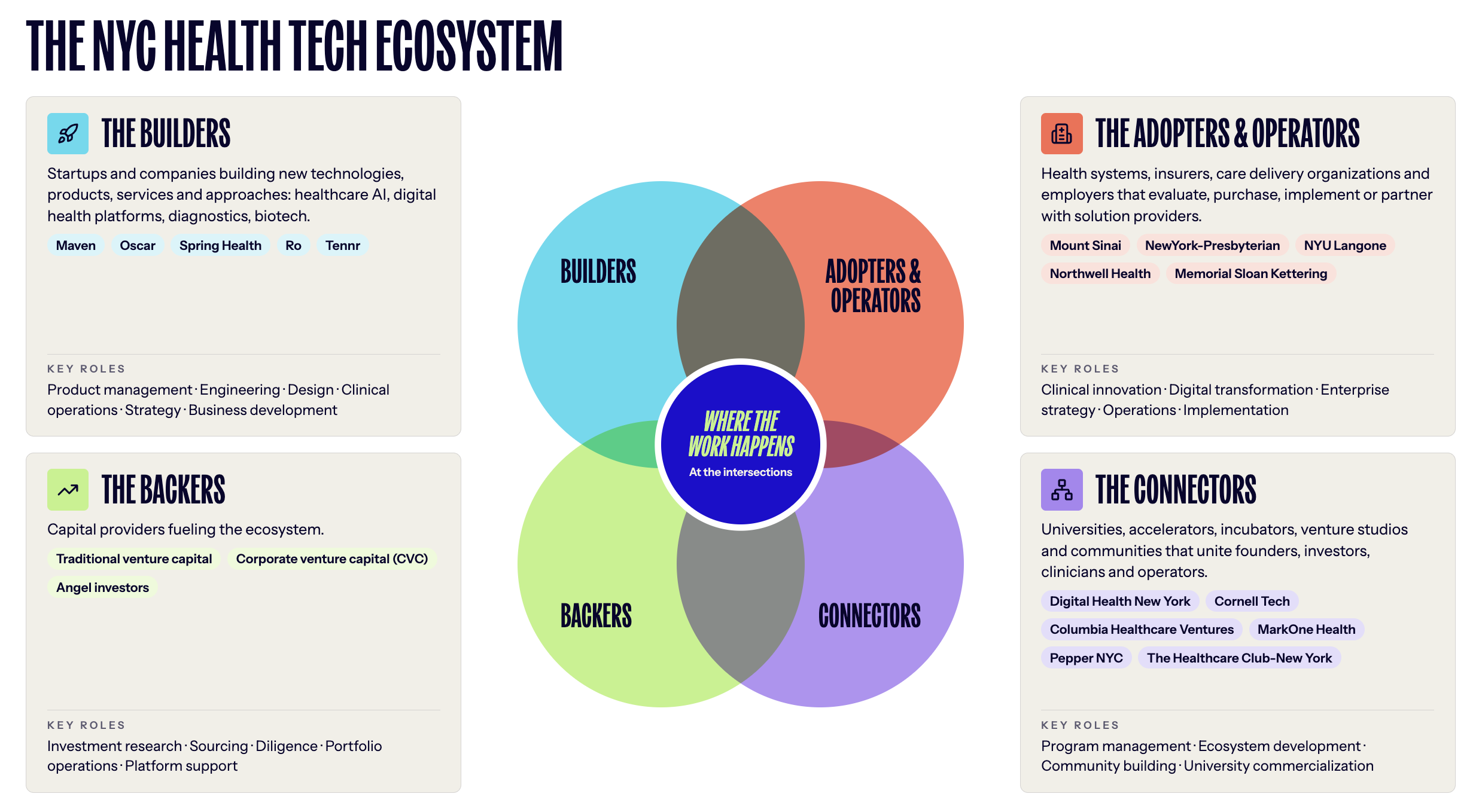
A startup might build a new technology, an investor might fund it, a health system might test and implement it, and an industry community might have brought those people together in the first place.
These organizations have different priorities, definitions of success, and ways of working. I find it helpful to think about the ecosystem in four overlapping groups: the builders, the adopters and operators, the backers, and the connectors.
The builders: Creating what's next
These are the startups and companies developing new technologies, products, services, and approaches to healthcare. In NYC, that includes everything from healthcare AI and digital health platforms to diagnostics, medical devices, and biotech. The city's startup ecosystem includes companies at every stage, from emerging ventures to established players like Maven, Oscar, Spring Health, and Ro. Digital Health New York's 2026 Digital Health 100 recognized 48 startups new to its list, underscoring the level of innovation happening here.
If you like building things, solving problems directly, and seeing your work take shape quickly, this might be a natural place to start. Startups tend to offer opportunities to work across functions, particularly early on when everyone wears multiple hats. Someone hired into product might also find themselves working on customer discovery, business development, implementation, or fundraising.
But there's an important distinction between moving quickly and making progress quickly. A startup might develop a new feature in weeks and then spend months navigating a health system's procurement process or integrating into existing clinical workflows. The person using a healthcare product is also often not the person paying for it, so even a technology that clinicians love may struggle if it doesn't make operational or financial sense to the buyer.
Where you might fit: Product management, engineering, design, clinical operations, strategy, business development, partnerships, customer success, and commercialization.
The adopters and operators: Making innovation work in practice
This group includes health systems, insurers, care delivery organizations, employers, and pharmaceutical companies. Some develop technologies themselves, but many also evaluate, purchase, implement, or partner with companies building new solutions.
NYC is home to major healthcare institutions including Mount Sinai, NewYork-Presbyterian, NYU Langone, Northwell Health, and Memorial Sloan Kettering. These organizations offer opportunities to drive innovation from the perspective of the people delivering and paying for care.
The challenges here are different from those at a startup. An exciting technology isn't necessarily the right technology for a particular organization. It must fit existing workflows, meet regulatory and security requirements, make financial sense, and earn support from stakeholders with competing priorities. And even after a technology is purchased, getting people to actually use it can be a challenge. In PHTI's 2026 survey, 47% of digital health purchasers reported that fewer than a quarter of their eligible members enroll in the solutions they offer.
I wouldn't automatically equate bureaucracy with resistance to innovation, either. Healthcare organizations have responsibilities that startups don't, particularly when patient safety is involved. Good governance can actually help promising technologies reach patients more reliably. And while larger institutions can take longer to make decisions, they can also implement solutions at a scale that would take a young company years to reach.
Where you might fit: Clinical innovation, digital transformation, enterprise strategy, operations, product, technology, implementation, partnerships, and business development.
The backers: Funding what’s next
Backers include traditional venture capital firms, corporate venture capital teams, angel investors, and other organizations providing capital to healthcare companies. It's a much broader landscape than it might initially appear. In our research mapping 152 venture firms and more than 3,600 digital health investments, we found enormous differences in how investors operate, from fund size and investment focus to the types of companies they back.
If you enjoy understanding emerging markets, evaluating business models, researching new technologies, and developing a perspective on where an industry is heading, this part of the ecosystem may appeal to you.
Venture investing involves much more than identifying interesting startups. U.S. digital health startups raised $11.1 billion across 358 deals in the first nine months of 2026, but deciding which companies are worth backing requires more than enthusiasm for an emerging technology. Investors need to understand how companies make money, whether their products can achieve meaningful adoption, what differentiates them from competitors, and whether the potential return justifies the risk. A great healthcare product isn't necessarily a great investment.
It's also worth distinguishing between traditional and corporate venture capital. Traditional VC firms primarily invest on behalf of their funds and limited partners, while corporate venture teams operate within the context of a larger organization. Some are primarily financially oriented; others connect investment activity with broader strategic priorities.
That can make certain corporate venture roles surprisingly similar to health system innovation or enterprise strategy. Both can involve navigating large organizations, understanding competing business priorities, and identifying opportunities that make sense within a much bigger picture. Corporate venture teams may also have platform, portfolio development, or partnerships roles that look very different from traditional deal investing.
Where you might fit: Investment research, sourcing, diligence, portfolio operations, strategy, platform, business development, and portfolio company support.
The connectors: Bringing the ecosystem together
This might be the least obvious category, but it's an important one, especially for people just getting started.
Connectors include universities, accelerators, incubators, venture studios, industry organizations, professional communities, and the people who bring founders, investors, clinicians, and operators together.
In NYC, organizations and communities like Digital Health New York, Cornell Tech, Columbia's healthcare entrepreneurship programs, MarkOne Health, and Pepper NYC create opportunities for people from different parts of the industry to meet, exchange ideas, and collaborate.
Some help entrepreneurs turn research into companies. For example, Cornell Tech welcomed 13 startups into its Runway programs in fall 2026, giving founders access to funding, mentorship, and support to turn research into commercial ventures. Others provide mentorship, connect founders with potential customers or investors, or create spaces where people who otherwise wouldn't cross paths can meet.
And you don't necessarily need a formal job in one of these organizations to contribute. Students can organize events, researchers can bring insights to a community, and professionals can become valuable connectors by developing expertise and building relationships.
Where you might fit: Program management, ecosystem development, partnerships, community building, university commercialization, accelerator operations, research, and events.
The interesting work often happens between these groups
Of course, these categories aren't mutually exclusive. A health system might develop technology internally, invest in a startup through its corporate venture arm, and become a customer of another startup. A venture studio might fund companies, help build them, and connect them with commercial partners.
And despite how different these organizations look, I've been struck by how similar some of the underlying skills can be.
Across investing, clinical innovation, startups, and partnerships, there's enormous value in being able to translate between people who see the same opportunity differently. A founder sees an exciting product. A clinician sees how it might change patient care. A CFO sees the economics. An investor sees the risks and potential upside. All of those perspectives can be valid at the same time. In our research with 24 healthcare founders, workflow integration emerged as the most frequently cited source of defensibility, reinforcing just how much success in healthcare depends on understanding the people, systems, and processes surrounding a technology.
There's also a shared need for discernment. So much of healthcare innovation involves deciding what not to pursue. Investors turn down companies, health systems decline technologies, startups pass on partnerships, and accelerators have to choose where to focus their resources.
I've come to think there's a real art to a well-done no. Sometimes the answer isn't that an idea is bad, but that the timing is wrong, the organization isn't the right fit, or someone else is better positioned to help. Recognizing that distinction, communicating it clearly, and preserving the relationship is a valuable skill across the ecosystem.
For someone coming from another industry, that's encouraging. You may already have experience translating between teams, influencing people you don't manage, navigating organizational complexity, or making decisions with incomplete information. Those skills don't suddenly become irrelevant because you're moving into healthcare. The challenge is learning enough about the industry to apply them well.
Get in the mix
One of the best things about healthcare is that you don't need to work in the industry to care about it. Healthcare touches all of our lives. Everyone has experienced some part of the system, whether as a patient, a caregiver, or someone trying to help a loved one navigate it. Chances are, you've had at least one moment where you thought, there has to be a better way to do this.
That perspective is worth something. It doesn't replace clinical expertise or an understanding of how the industry works, but it's a perfectly good place to start getting curious.
The harder part is figuring out how to turn that interest into experience and relationships. My biggest advice is not to wait until you have a healthcare job to start doing healthcare work.
Find ways to contribute before you have the title
There are more ways to gain experience than you might think, including some that don't require a formal internship or a healthcare degree.
Venture fellowships are one of my favorite examples. Some funds offer opportunities for students and professionals to get involved in sourcing, market research, or investment diligence. They're a great way to get exposure to emerging companies, understand how investors evaluate opportunities, and develop a perspective on where the industry is headed. They're also useful even if you have no intention of becoming an investor. Learning how to evaluate a company's business model, customers, and competitive landscape translates to plenty of other roles.
You can also create opportunities more informally. If you're talking with an investor, founder, or industry leader, ask what areas they've been interested in lately. Is there a market they're trying to understand, a technology they're curious about, or a problem they keep encountering? You might offer to pull together some research or share what you've been learning.
This doesn't have to be a major undertaking. A thoughtful market map, a few interesting companies, or a short perspective on an emerging trend can be genuinely helpful. And doing the work gives you something more substantive to discuss than simply telling someone you're interested in healthcare.
The same applies outside venture. You might help a startup think through customer discovery, contribute to a research project, volunteer with an industry organization, or get involved in planning an event. Look for opportunities that let you learn something and produce something useful.
Get involved in the community (and don't just attend)
NYC has an unusually active health tech community, and many of its organizations are open to people still exploring the industry.
Our NYC Health Tech Guide includes communities like Digital Health New York, MarkOne Health, Pepper NYC, and The Healthcare Club-New York, along with universities, accelerators, and other organizations that host events throughout the year.
I'd encourage you to start showing up, even if you don't know anyone. Smaller dinners, workshops, and community gatherings can be great opportunities for real conversations rather than exchanging a dozen LinkedIn profiles.
But don't overlook the opportunity to get involved beyond attending. Some communities welcome people who want to help organize programming, suggest topics, or bring interesting people together.
I've gotten involved with The Healthcare Club-New York by helping host small dinners around specific questions facing the industry. It's a fun way to meet people, but also an opportunity to shape the conversation. You don't have to be the most knowledgeable person in the room to bring together people who have something interesting to teach one another.
And you don't need to start by hosting anything. Offering to help with an event, contributing a topic, or introducing two people with overlapping interests can all be meaningful ways to participate.
Be curious, prepared, and useful
There's nothing wrong with reaching out to someone because you want to learn from them. I've found people in healthcare remarkably generous with their time, but it's important to approach those conversations with both humility and preparation.
Do your homework on their organization, the market they operate in, and any recent developments. I keep a running healthcare and venture news digest, using AI to synthesize reporting from industry newsletters and publications, organize relevant developments, and identify broader patterns worth paying attention to. Before a conversation, I'll use that as a starting point to dig into the person's organization and recent work, checking important details against the original sources. You don't need to become an expert overnight, just informed enough to ask thoughtful questions rather than expecting someone to explain their entire industry from scratch.
And as you build relationships, think about ways to be helpful in return. Maybe you come across an article they'd appreciate, meet someone working on a similar problem, or hear about a relevant event. These relationships can become meaningful in ways you might never anticipate. As Halle has written about her own experience, the relationships she built during business school helped connect her with Rock Health's earliest backers, including Nike, Mayo Clinic, and Kaiser Permanente. Not every interaction needs to be transactional or lead to something immediate, but being genuinely curious and thoughtful about other people's interests goes a long way.
Make your move
You don't need to tackle the entire NYC health tech ecosystem at once. Start small and follow what genuinely interests you.
Pick a corner of healthcare to explore. Maybe it's administrative AI, women's health, care delivery, or an entirely different area. Find a few companies and organizations doing interesting work and start learning how that market operates.
Find a way into the conversation. Attend a community event, join a relevant organization, or reach out to someone whose work interests you. Use the NYC Health Tech Guide as a starting point.
Contribute something. Offer to help with a project, organize a discussion, share some research, or make a useful introduction. Look for ways to participate rather than just observe.
Keep showing up. Follow the people and organizations you're interested in, keep learning, and stay in touch as your interests evolve. Above all, have some grit!
One practical habit I'd recommend is keeping a personal relationship CRM. Nothing elaborate, just a way to remember who you've met, what they're working on, and when you last connected. Healthcare is a surprisingly small world, especially in NYC, and people you meet in completely different contexts have a funny way of reappearing in your life. I regularly reconnect with people I met months or even years earlier, sometimes to share something relevant and sometimes just to catch up. Careers are long, and relationships don't have to be immediately useful to be worth maintaining.
Healthcare changed my life long before I ever thought about working in it, and I've found that almost everyone in this industry has a story about what brought them here. Whatever yours is, hold on to it. Be curious and generous, and remember that behind all the buzzwords, billion-dollar valuations, and AI hype, we're ultimately here to make people's lives better. You don't need to have your whole career figured out. Follow what excites you, spend time with people who inspire you, and trust that you'll find your way. The best ideas in healthcare haven't all been thought of yet. Maybe one of them will be yours.