How Healthcare Works in the Five Healthiest Countries
I spend a lot of time frustrated at our healthcare system. After all, we pay more for healthcare than every other nation, yet we have a lower life expectancy, spend more of our lives sick, and have the highest rate of avoidable deaths.
Why is it like this? How can we do this better? What can we learn from other countries?
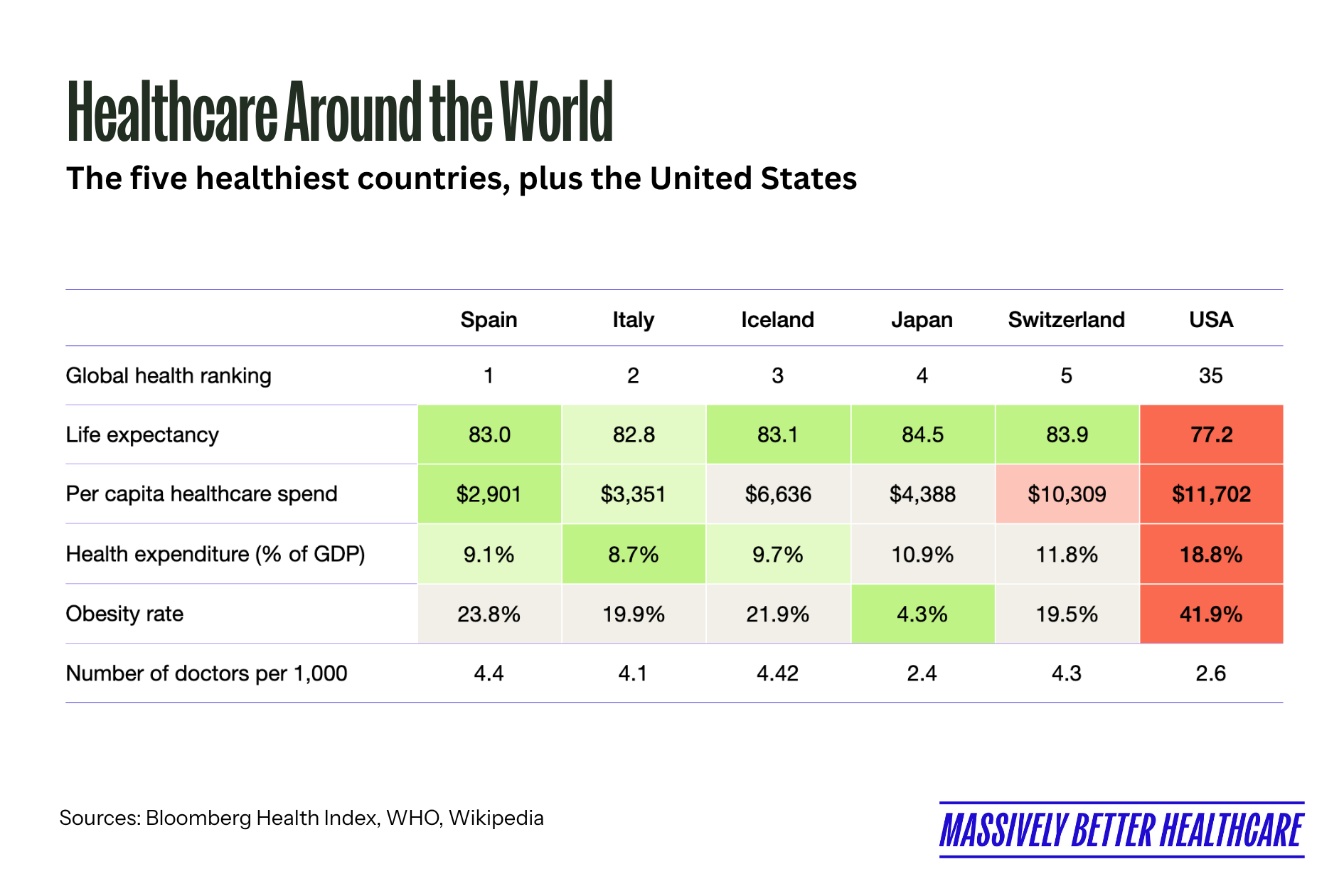
In this article, I’ll dive into the basics of how healthcare works in the five healthiest countries worldwide—Spain, Italy, Iceland, Japan, and Switzerland. By better understanding these countries’ healthcare systems, perhaps we can gain insights into successful models that prioritize human health and well-being.
🇪🇸 Spain
Life expectancy: 83
Per capita healthcare spend: $2,901
Health expenditure (% of GDP): 9.1%
Obesity rate: 23.8%
Number of doctors per 1,000 inhabitants: 4.4
How healthcare works: Spain offers universal healthcare coverage (via the Sistema Nacional de Salud; SNS), meaning everyone has health insurance paid for with tax dollars. Although about 10% of the population opts for private health insurance to enhance their coverage, most people rely on the publicly funded system.
Out-of-pocket expenses (co-payments for medicines, dental care, and medical devices like hearing aids) amount to 21.8%. Despite this, healthcare accessibility remains exceptional throughout the country. Merely 0.2% of individuals report barriers to medical care due to factors such as cost, distance, or waiting times.
Spain's commitment to health and well-being is evident in its remarkable health outcomes. The nation boasts some of the lowest mortality rates resulting from preventable and treatable causes. And according to the World Economic Forum and Bloomberg, Spain has the most efficient health system in Europe.
🇮🇹 Italy
Life expectancy: 82.8
Per capita healthcare spend: $3,351
Health expenditure (% of GDP): 8.7%
Obesity rate: 19.9%
Number of doctors per 1,000 inhabitants: 4.1
How healthcare works: Italy also stands as a beacon of universal healthcare coverage, demonstrating its commitment to healthcare as a human right. Under the system known as the Servizio Sanitario Nazionale (SSN), health insurance is primarily funded through public resources. Each region is responsible for organizing and delivering health services through both public and accredited private hospitals.
Italy also has a strong culture of public health and prevention, with spending on preventive measures above the European Union (EU) average. As part of the Gaining Health Program, public health campaigns include health promotion activities in schools and nutrition literacy campaigns.
Italy has remarkably low hospital admission rates for chronic diseases. This reflects the efficacy of the primary care system, where general practitioners serve as gatekeepers. In certain regions, multidisciplinary teams provide acute and chronic care, as well as preventive services for the entire population.
🇮🇸 Iceland
Life expectancy: 83.12
Per capita healthcare spend: $6,636
Health expenditure (% of GDP): 9.65%
Obesity rate: 21.9%
Number of doctors per 1,000 inhabitants: 4.42
How healthcare works: Iceland's healthcare system is primarily publicly funded and is built on the core principle of universal coverage (do you sense a pattern here?). A distinctive characteristic is the integrated purchaser-provider relationship, where the government acts as both the payer and owner of most health service organizations. Approximately 15% of healthcare expenditures come from out-of-pocket payments, predominantly for pharmaceuticals, dental care, and outpatient medical services.
Only about 3% of Icelanders report unmet medical needs. However, like many other healthcare systems, excessive waiting times have been a persistent challenge (e.g., in 2020, half of patients seeking cataract surgery waited over three months, while two-thirds experienced similar delays for hip replacement procedures).
Surprisingly, preventive care receives relatively less financial investment. Nevertheless, public health efforts in Iceland include nutritional standards in schools, prohibiting food and beverage advertising on TV and radio during times when children are the primary audience, and utilizing the Nordic keyhole nutrition label to promote healthy eating. Like Italy and Spain, Iceland exhibits one of the lowest mortality rates for treatable causes.
🇯🇵 Japan
Life expectancy: 84.45
Per capita healthcare spend: $4,388
Health expenditure (% of GDP): 10.9%
Obesity rate: 4.3%
Number of doctors per 1,000 inhabitants: 2.4
How healthcare works: Japan's healthcare system operates on a social health insurance model, ensuring that all citizens and residents have access to healthcare. Mandatory health insurance enrollment is required, and the government regulates fees to keep costs affordable and access broad. Most services have a 30% coinsurance (lower for low-income adults), and there’s an annual household out-of-pocket maximum for healthcare expenses based on income and age. Approximately 14% of healthcare expenditures come from out-of-pocket payments.
At its core, Japan places a strong emphasis on primary care, prevention, and regular health check-ups. Interestingly, Japan has no institutional or financial distinction between primary care and specialty care. The vast majority (83%) of providers are privately owned and managed by physicians or by medical corporations, but the government sets the prices.
The government actively promotes preventive care measures to detect diseases early and encourage healthy lifestyles among the population. This commitment to prevention extends to various aspects of public health, including health education and awareness campaigns. Meanwhile, the traditional Japanese diet (washoku), with an emphasis on seafood and vegetables, emphasizes whole, minimally processed ingredients that naturally support physical health.
🇨🇭Switzerland
Life expectancy: 83.85
Per capita healthcare spend: $10,309
Health expenditure (% of GDP): 11.8%
Obesity rate: 19.5%
Number of doctors per 1,000 inhabitants: 4.3
How healthcare works: In Switzerland, residents must purchase health insurance from private (non-profit) insurers regulated by the government. To access healthcare services, adults are subject to yearly deductibles and coinsurance, with a cap ($579 USD) on the annual amount paid.
Switzerland's healthcare system combines public and private ownership of healthcare providers. Patients typically begin their healthcare journey with an initial consultation with a family physician, who acts as the gatekeeper.
While the Swiss benefit from great health outcomes, their healthcare costs are the second-highest in the world, only behind the United States.
What can the U.S. learn from the healthiest countries?
Despite our status as one of the world's wealthiest nations, the U.S. grapples with challenges regarding healthcare accessibility, affordability, and health outcomes. By comparing the U.S. system with those of the healthiest countries, we can identify areas for improvement and learn from international best practices.
Things that stand out to me:
Universal coverage. All five countries ensure that healthcare services are accessible to all citizens. Our absence of universal coverage and fragmented financing contribute to disparities in healthcare access and quality. (Shockingly, the individual health insurance market in the U.S. is $1.6T, more than the total healthcare expenditures of all five of these countries combined).
Preventable deaths. Compared to peer nations, the U.S. has among the highest number of hospitalizations from preventable causes, and the highest rate of avoidable deaths. An emphasis on primary care and preventive measures lays the foundation for early detection and disease prevention in these peer countries. (I will give the U.S. a shout-out for flu vaccinations and breast cancer screening, where we outperform peer nations.)
Integrating the public and private sectors, coupled with effective regulation, creates a balance between effectiveness and equity. We also have fewer doctors than all the countries except Japan. Perhaps that’s why Americans have fewer physician visits than most of our peer countries too.
The obesity rate in the U.S. is 2-10x higher than these nations. Obesity is a key risk factor for chronic conditions such as diabetes, cardiovascular diseases, and cancer. These five countries invest in public health promotion and recognize the impact of obesity on overall well-being and chronic disease. Determinants of obesity include unhealthy living environments, less-regulated food and agriculture industries, and socioeconomic and behavioral factors.
What do you think? What else can we learn from these healthcare systems and others?
Up Next: Why Are Americans So Unhealthy?