
Must-Read Books for Anyone Building, Investing, or Working in Healthcare Innovation
Healthcare is unlike any other sector. Progress is slower, incentives are misaligned, incubments are powerful, and complexity is structural. To successfully build, invest, or work in this industry, good intentions and clever technology are not enough: you need to understand how the system actually works.
This curated list of foundational books for healthcare innovation is designed for serious professionals. They help explain why healthcare behaves the way it does, where innovation succeeds or fails, and how to design solutions that can survive real-world constraints like regulation, reimbursement, and entrenched incumbents.
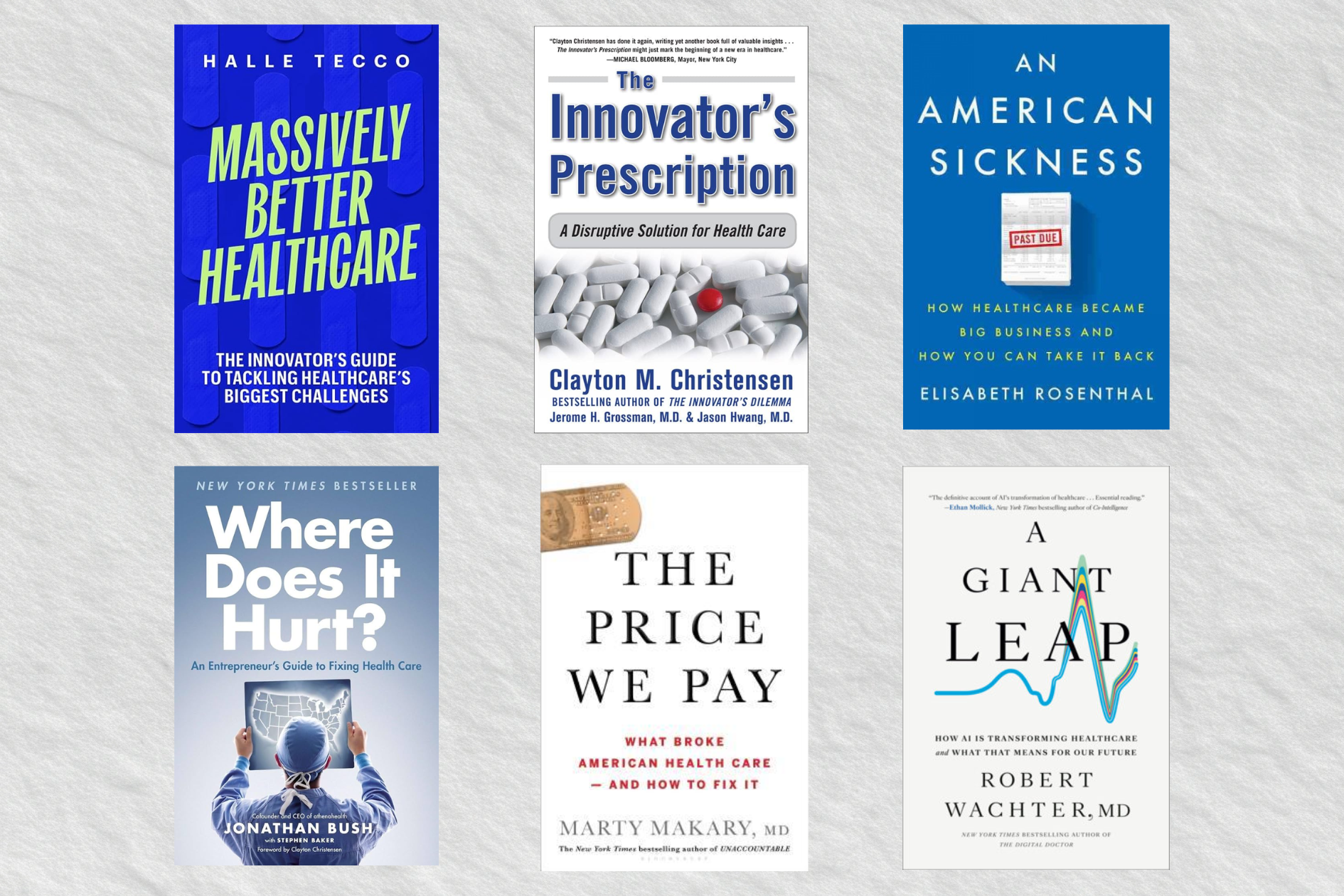
1. Massively Better Healthcare by Halle Tecco
Best for: A crash course in healthcare—and how to transform it through innovation
Drawing on her experience as an entrepreneur, investor, and educator, Halle Tecco introduces four rules for building healthcare solutions that can scale within real-world constraints.
Through case studies and practical frameworks, the book explains why healthcare is hard, who holds power, how to align mission and margin, and how to generate evidence that earns trust. It is a pragmatic guide for anyone trying to change healthcare without being broken by it.
2. The Innovator’s Prescription by Clayton Christensen
Best for: Understanding disruption theory in healthcare
This book applies disruption theory to healthcare and explains why some innovations succeed while others stall. The authors distinguish between different types of care and care settings, helping readers understand why hospitals, clinics, and digital tools behave so differently. While some examples are dated, the conceptual framework remains useful.
3. An American Sickness by Elisabeth Rosenthal
Best for: Understanding cost drivers and perverse incentives
Rosenthal dissects how pricing works—or fails to work—in U.S. healthcare. She explains how hospitals, insurers, pharmaceutical companies, and intermediaries extract revenue in ways that are often decoupled from patient outcomes.
Rosenthal is a physician by training and spent 22 years as a correspondent with The New York Times. Her book is well-researched and well-written.
4. A Giant Leap by Robert Wachter
Best for: Getting up to speed on AI in healthcare
Physician and health system leader Robert Wachter offers a clear-eyed assessment of generative AI’s role in healthcare—steering between hype and fear. Drawing on more than 100 interviews across medicine, technology, and policy, he shows how AI is already being used to draft notes, answer patient questions, interpret images, and support clinical decision-making.
Wachter confronts real risks, including hallucinations, bias, and overreliance, while making a pragmatic case: in a system strained by cost, complexity, and clinician burnout, AI does not need to be perfect—it needs to be better.
5. Where Does It Hurt? by Jonathan Bush
Best for: Getting an inside look at building a health tech company
Jonathan Bush, founder and former CEO of athenahealth, offers one of the most candid insider accounts of what it actually takes to build a healthcare company at scale. The book is part memoir, part operating manual, and part critique of the system’s inefficiencies—from billing complexity to regulatory friction.
Where Does It Hurt? is grounded in lived experience: selling to hospitals, dealing with government programs, navigating incumbents, and making trade-offs that are unavoidable when you operate in healthcare rather than around it.
6. The Price We Pay by Marty Makary
Best for: Clinicians and operators interested in system redesign
Surgeon and health policy expert (and now Commissioner of the FDA) Marty Makary examines how U.S. healthcare became so expensive without delivering commensurate improvements in health. Drawing on reporting, research, and firsthand clinical experience, he traces rising costs to opaque pricing, layers of intermediaries, and financial games that have little to do with patient care.
Makary shows how a significant share of healthcare spending flows to administrative complexity rather than health outcomes, contributing to medical debt, clinician frustration, and declining public trust. The book also highlights efforts to restore transparency and accountability, offering a grounded look at how parts of the system could be reoriented toward patients rather than revenue extraction.
