A Founder’s Guide to Building and Managing a Board
Written by Carly Newhouse, LCSW
Edited by Halle Tecco, MBA, MPH

A successful co-founder and CEO of a growing health tech company confided that she felt manipulated and broken down by her board. Competition in the space was heating up, and the board did not seem open to hearing her ideas. She felt like a human punching bag. The board had pressured her to hire a C-suite leader she knew was not right for the business at a high salary, using capital they badly needed for sales infrastructure. The downstream impact was talent and momentum leakage, plus a major toll on her mental health. The CEO came to feel her only option was to quit the business she had so caringly built.
The CEO shared her struggles with me as a friend, so I tried to enlist help. Every person I turned to for guidance shared their own board war stories and hard-won lessons. Investors are professional board members – with around 15% of them holding more than four board seats simultaneously, per Pitchbook’s Startups beware: Juggling board members may drop the ball. On the other hand, most founders/CEOs have limited, if any, board experience, leaving them at a disadvantage. There is a glaring lack of honest, practical guidance on how to form a board that will be an asset to a founder/CEO operationally and emotionally — good stewards of the business and caring colleagues.
To fill that gap, we talked to founders, operators, board members, consultants, lawyers, and investors, and rounded out those discussions with market research. Here are the key topics we’ll cover:
When to form a board, and what it looks like by stage
The purpose and inherent tension of boards
Building an effective board
The independent director as a key asset
Leading a high-functioning board
How to involve employees before, during, and after board meetings
Note: While not all founders are CEOs, we use the term founder/CEO to reflect the frequency of this combination, especially for earlier-stage companies.
When to form a board, and what it looks like by stage
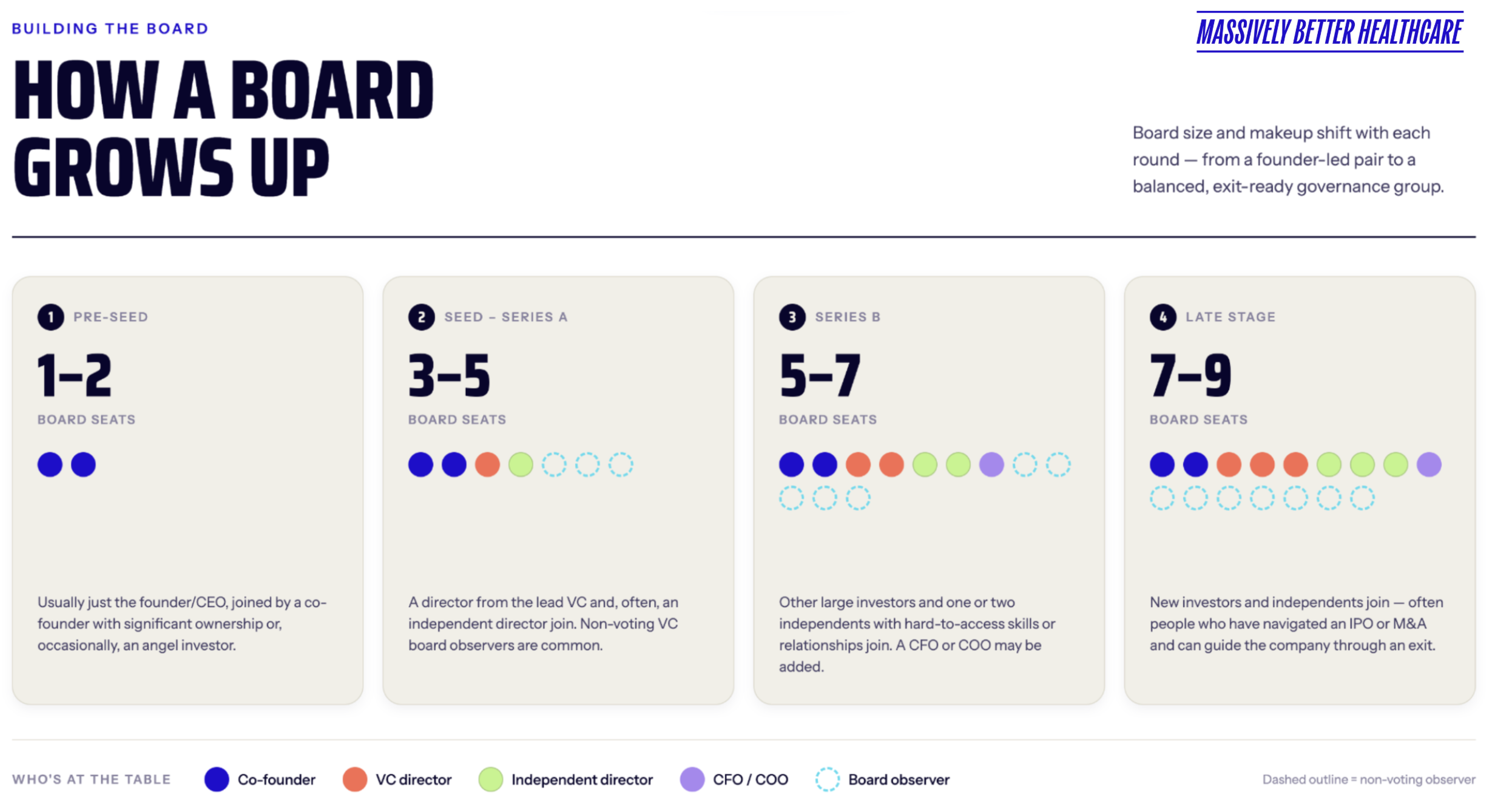
As soon as founders incorporate into a Delaware C-corp, the company is legally required to have a board. Even early on, when the board may be informal, Michael Esquivel, JD, Partner at Fenwick & West (and co-host of the Heart of Healthcare podcast!), urges founders to follow basic business hygiene: documenting decisions and maintaining a clean cap table to avoid future governance problems.
Here’s the typical board composition by stage:
Pre-Seed: 1–2 people. Usually the founder/CEO and a co-founder who has significant ownership or, occasionally, an angel investor.
Seed–Series A: 3–5 people. A director from the lead VC investor and, often, an independent director is brought in. VC board observers, who attend board meetings and receive materials but have no voting power, are also common.
Series B and beyond: 5–7 people. Other large investors and one or two independent directors with skills or relationships that the business can't otherwise access may join. The CFO or COO may also be added to the board.
Late stage: 7–9 people. New investors and additional independent directors may join, particularly people who have navigated a public offering or M&A and can provide guidance through the exit process.
Aim for an odd number of directors to reduce the risk of deadlock. As the company grows, the board will likely grow with it, but every new seat should have a clear purpose. More directors bring more perspectives and expertise, but they can also make alignment and decision-making more complicated.
The purpose and inherent tension of boards
The board of directors has a legal obligation to act in the company's best interest and be accountable to its shareholders. The board fulfills this obligation by supporting the business across core functions, such as those included in Gregg Adkin’s SPIFS framework: Strategy, People, Image, Finance, and Systems Compliance. This obligation also enables boards to take sweeping actions such as approving a sale or firing the CEO.
Determining and executing on what is in the business’s best interest is where things get sticky. The board is made up of people who, like the rest of us, come to the table with their own biases, bruises, and bosses. Founders and CEOs are most focused on the company's mission and leadership, as well as protecting their ownership stake. Investors, on the other hand, are under pressure to generate returns for their fund.
Therein lies the challenge. What's best for the company, founder, employees, customers, and investors isn't always the same. A founder may want to keep building for another decade, while an investor needs liquidity. A founder may want to sell for a life-changing outcome while an investor believes the company needs to keep going to generate a meaningful return for the fund. Everyone can be acting rationally and in good faith while pulling in different directions.
Independent directors can be particularly valuable in these moments of misalignment. They don't represent management or a particular investor interest, so they can bring a more objective perspective when those interests diverge.
Building an effective board
Why do many founders/CEOs find themselves entrenched in a challenging board dynamic? The answer is part structural and part strategic. Building an effective board requires getting a few key things right. Let's break those down.
Negotiate board governance thoughtfully from the beginning
Liz Rockett, MBA, MPH, CEO board advisor and former investor, explains that founder/CEOs’ ability to build effective boards rests heavily on the terms negotiated during the capital raise(s).
While it’s tempting, especially for first-time founders, to sign these docs quickly to expedite the fundraising process, these terms are the founder/CEO’s opportunity to establish a governance structure that will protect them and the company for many years to come.
Here are two key governance documents that lay out founder and investor power on the board of directors:
Term Sheet: Although this document is preliminary and non-binding beyond confidentiality and exclusivity, it sets the tone for the formal agreement that follows. Strongly consider including language stating that the independent director seat must be mutually acceptable to both common and preferred shareholders, rather than investor-appointed.
Voting Agreement: This is the critical document codifying board seat allocation, appointment, and voting power. Regardless of whether this language was agreed to in the Term Sheet, it’s critical to include the language defining the independent director as a mutual designee by the founder/CEO and investor(s) in the binding Voting Agreement. Founders/CEOs should also:
Ensure it’s clear that voting strength is measured per share, which generally retains founder/CEO voice, at least early on.
Consider including language that the right to designate a board member does not transfer to an assignee of the shares.
Tom Cassels, MPP, Managing Director at Manatt Health Strategies, also recommends using a board charter that specifies that external counsel will be selected by the founder, not automatically from the investors' preferred firm. Even when counsel's duty is to the company, relying on a law firm with deep ties to the fund can create real or perceived conflicts, particularly when the interests of founders and investors diverge.
Build a board for where you're going, not where you are today
Once you’ve negotiated terms and are ready to put the board in place, Jessica Loché-Eggert, Managing Partner at Madison West and serial entrepreneur, recommends "building a board for the company you’re becoming, not the one you are today." The board should be composed of people who have navigated the challenges the company will be facing next and can offer strategic, regulatory, and tactical support.”
Mia Jung, MBA, Talent Partner at Welsh, Carson, Anderson, and Stowe (WCAS) and Co-founder of Break into the Boardroom, recommends aligning board composition to business strategy and value creation goals. Hone in on the functional or industry expertise the business needs and consider pairing board members with employees in the aligned roles, such as connecting the board member with cybersecurity expertise to the CTO directly. Especially early on, founders/CEOs should seek out board members who are operators and can help the company figure things out by getting in the weeds. As the company scales, the board’s contribution becomes more about pattern recognition, governance, and helping navigate larger decisions such as financing, M&A, and other exit opportunities.
Co-founder and CEO at Seen Health, serial entrepreneur, investor, and board member Lori Evans Bernstein, MPH advises against bringing on board members without operational experience: "an investor who has never operated a business and has not been on a board is a recipe for disaster." Lori believes a worthwhile board member needs one skill-set or the other — operational depth or meaty board governance experience. Ideally both.
"If somebody has never dealt with decision-making under ambiguity, they're not qualified to help you." — Vinod Khosla
Khosla Ventures founder and entrepreneur Vinod Khosla makes a related point about investors more broadly, saying they need to “earn the right to advise an entrepreneur,” rather than automatically having that right by virtue of being an investor. Per Vinod: “If somebody has never dealt with decision-making under ambiguity, they’re not qualified to help you.”
Optimize for balance, not agreement
Founders/CEOs should optimize for varied expertise around the board table to create balance. Jacob Reider, MD, serial entrepreneur, investor, and board member, recommends using the CliftonStrengths tool (f.k.a Strengthsfinder 2.0) to identify where the board is over- or under-saturated on particular skills. This tool measures and situates people across character traits and domains:
Executing domain - the doers
Influencing domain - the ones who take charge
Relationship Building domain - you guessed it, the ones who build relationships
Strategic Thinking domain - the analyzers
Lori Evans Bernstein has worked with board members willing to tap their expansive networks to materially improve her business, including getting into the details on acquisition diligence by reviewing customer contracts in a time crunch.
While that kind of domain support is lovely, Redox CEO and .406 Ventures’ VC partner Trip Hofer, MBA doesn’t recommend founders/CEOs expect much beyond capital from their investor board members. Trip shared that the investors on his companies’ boards have focused squarely on company financials and sometimes provided sales referral support. For specific support, Trip relied on his independent directors (more on this stakeholder below).
Beyond domain expertise, founders/CEOs should seek out values alignment when considering board members. Josh Liu, MD, Co-founder and CEO of SeamlessMD, prioritized this in choosing a board member whose values of being “unapologetically customer-centric and doing right by employees” mirrored his own. This board member reinforced and helped Josh amplify these values across the company. Of equal importance, the board member helped align the rest of the board around these values as the company’s North Star. In selecting this board member, Josh chose a culture accountability partner who would protect the company from straying from the values on which it was built.
To get a deep understanding of a prospective board member and their values, Liz Rockett strongly recommends founders/CEOs back-channel with a handful of other portfolio company founders/CEOs about what it’s like to work with this person. In her experience, those conversations are the best way to understand the dynamic the person could bring to the board. When there is value alignment, founders/CEO’s won’t be as tempted to stack the board with people who are “on their side.” Instead, founders/CEOs should seek out those who will tell them the truth, challenge them, support them, and show up consistently.
The independent director as a key asset
Independent board directors — those without a material financial interest in the company beyond their equity compensation for board membership — can be the most consequential board members. Tom Cassels, MPP recommends founders/CEOs establish a board sub-committee whose sole mandate is to recruit and vet the person who will occupy the independent director seat. There should be a strict requirement to conflict-check independents against everyone else on the board. That separates the selection process from investor influence and gives the founder/CEO structural leverage.
The people we interviewed generally agree that independent directors should join at Series A or soon after, to balance the board before investor seats dominate. To vet prospective independent directors, have them interview with all existing board members and key members of the executive team. Liz Rockett also recommends having the candidate sign a confidentiality agreement and sit in on a board meeting, giving everyone a chance to experience the working dynamic before committing to having that person join the board.
Unless there are several experienced founders on the board who are aligned and even then, waiting too long to appoint an independent is a common, costly mistake that Lori Evans Bernstein knows from experience. While CEO, Lori delayed filling the independent director seat after a brief conversation with her board where all agreed that the board was becoming too large thanks to the presence of several Observers. “Looking back on it, I should have limited the Observers and filled the independent seat. The independent seat is so key for good governance and managing conflicts, especially in transaction scenarios.” That’s why Aequitas Partners’ Founder and Managing Partner Tim Gordon and Sr. Principal and Head of Development Polina Hanin, MBA recommend the founder/CEO always prioritize filling that independent seat and having that independent serve as board chair. If the founder/CEO leaves the independent seat open, it will often get filled by someone investors recommend. That investor-affiliation can be seen as weakening the independent's ability to be a neutral and objective force on the board.
"The most effective independents know how to hold a founder accountable and still show genuine care for them as a person." — Michael Esquivel
The independent should augment the current board in domain knowledge and have the credibility to stand up to both the founder/CEO and investors. Liz Rockett explains, “venture-backed boards are full of people who work together on other companies and deals.” As a result, often even if they disagree with another investor, their instinct is to agree to preserve their relationships. That means the voice of the independent is a critical one in helping balance the power structure. For Michael Esquivel, JD, who has been part of hundreds of boards in his career, “the most effective independents know how to hold a founder accountable and still show genuine care for them as a person.”
Learn more about independent board directors in What Independent Board Members Do (And How They're Compensated).
Leading a high-functioning board
Founders/CEOs who are able to build effective boards treat board members the way great managers treat their best employees: with transparency, regular communication, clear expectation setting, and enough vulnerability that the board can provide help. Lee Shapiro, Managing Partner, 7wireVentures, believes founders/CEOs with engaged boards "should be spending 20% of their time leveraging their board. That sounds like a lot, but if your board members are mentoring you, engaging in business development, and connecting you with resources, it's time well spent."
“Founders/CEOs should be spending 20% of their time leveraging their board." — Lee Shapiro
Setting expectations in advance and using consistent processes for engagement supports smooth board management. Lori Evans Bernstein shared the engagement structure she uses and recommends: "Have an established process and routine — calls before meetings, the meeting itself, and calls after, so you aren't managing your board but spending your time running a business." Whether it’s Lori’s process or something different, take the necessary steps to ensure all board members are on the same page. When board members are regularly in the loop, nothing should come as a surprise.
Here are some of the other recommended tactics to maintaining board effectiveness:
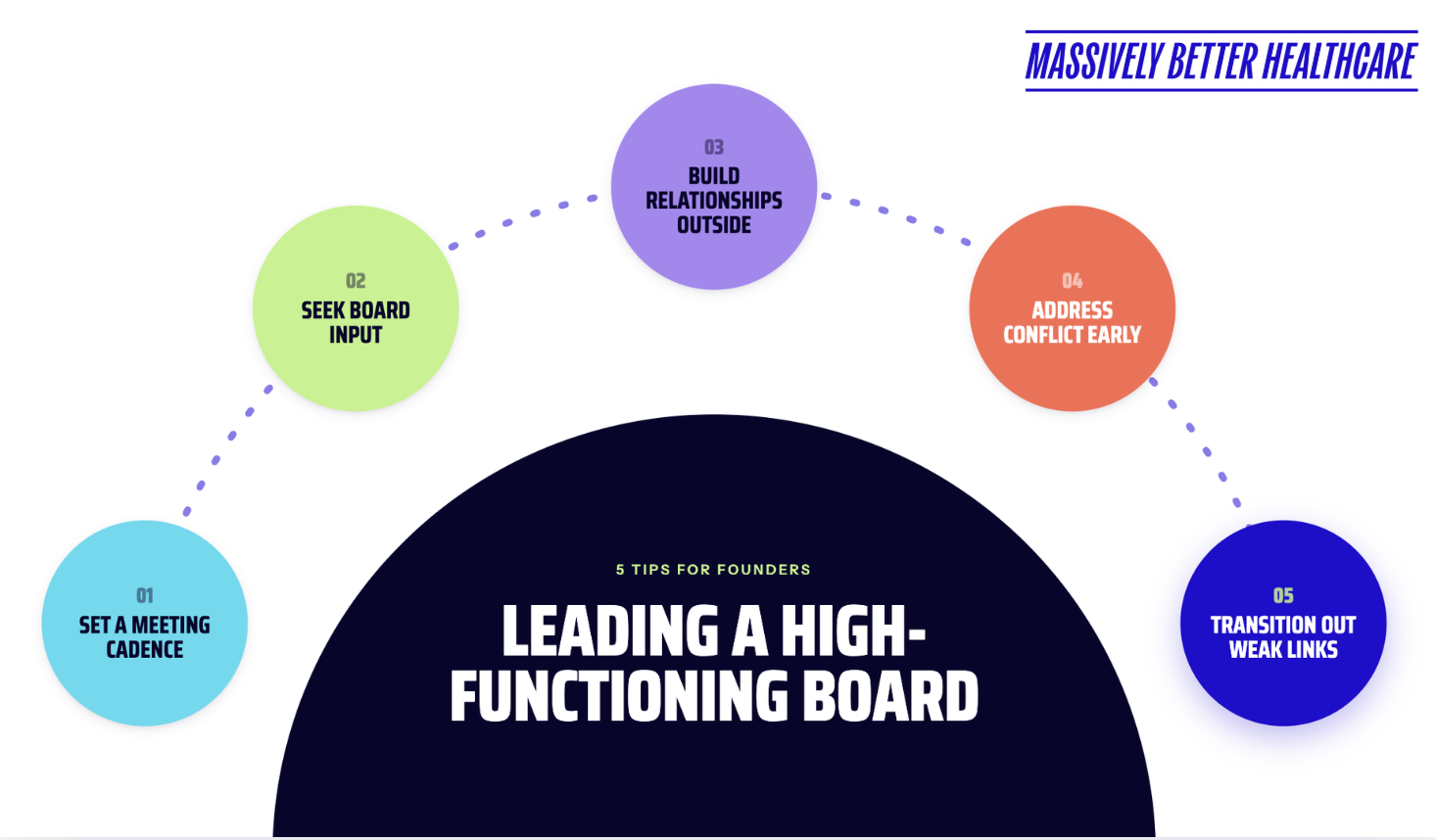
Establish a meeting cadence and structure
Board meetings should happen on a regular schedule, typically quarterly, with pre-reads sent in advance covering major company updates and performance, along with a meeting agenda. Jacob Reider, MD recommends distributing a thorough state-of-the-company document covering successes, challenges, and open questions well before the meeting, with the explicit expectation that board members read all materials in advance. Ideally the board should meet in person, twice a year at a minimum. This is important to build relationships with the company leadership team as well as between board members.
Focus on getting board input to guide decision-making
Board meetings should be spent discussing strategic and operational challenges, not on an operations review. Some founders/CEOs have leaders from every operational area speak about their accomplishments at the meeting, but resist that temptation to preserve time for meaningful board discussion. Jessice Loché-Eggert recommends founders/CEOs prepare one to three meaty questions for the board to discuss that drive toward outcomes. A board that only receives information becomes passive. A board that is regularly asked for input stays engaged.
If there is a key decision before the founder/CEO, they should prepare targeted questions for the board meeting to help shape their own thinking. Liz Rockett rightly points out that it’s important to get board input, but ultimately all decisions outside of fundraising, acquisition, sale, and anything uniquely contracted are the responsibility of the founder/CEO. They alone bear that burden and should not outsource decision-making to the board, especially if current board members don’t have the relevant skill-set and knowledge to credibly guide decision-making on that business challenge.
Build relationships outside the boardroom
Board dinners before meetings, informal 1:1 calls between quarters, genuine personal familiarity are need-to-haves. They are what make the board function well, especially when things get hard.
Address conflict early
When a board relationship is going south, the warning signs can show up at either extreme. Some board members disengage, becoming difficult to schedule, skimming or ignoring company updates, showing up unprepared, or missing meetings altogether. Others become too involved. Trip Hofer, MBA, sees a key warning sign when investors start "running the company" rather than providing guidance. Misalignment on strategy can further strain either dynamic.
Michael Esquivel recommends addressing conflict early (and the therapist in me heartily agrees!). If a board relationship is fraying, don't avoid it, hoping it will magically right itself. Michael shared his experience seeing boards where a single damaged relationship paralyzed decision-making for the better part of a year!
Strategically transition out any ineffective board members when possible
A new fundraise is the cleanest opportunity to make structural changes to the board. Having a new board member join from the most recent raise presents a unique opportunity to ask the ineffective board member to rotate off out of a desire to “keep the board small and phase appropriate,” per Liz Rockett. There may still be a power struggle, with people vying to keep their seats, but if it’s important to the founder/CEO to get a particular member off the board, it’s often worth navigating the politics to try to make that change.
Don’t shy away from getting help if needed
Sometimes, board dynamics become so toxic that founders/CEOs find themselves at a complete loss about how to move forward. If talking to fellow founders and mentors hasn’t helped resolve the issue, it may be useful to hire an outside CEO coach or advisor to help normalize the struggle and strategically navigate board landmines.
How to involve employees before, during, and after board meetings
The board may be accountable to shareholders, but its decisions affect the entire company. Thoughtfully involving employees in the board process can give members of the board better access to the people actually running the business while helping employees understand the decisions that come out of the boardroom.
Before the meeting, tap your team for input
The CEO should own the board meeting, but preparing the board deck and materials involves numerous people on the executive team. Department heads and other key executives can help surface the most important updates, challenges, and decisions facing their areas of the business. Their input can help shape both the board materials and the questions the CEO brings into the room.
During the meeting, bring in the right leaders
Members of the executive team and department heads often join portions of the meeting to present on their area of the business and answer questions directly. This gives the board access to subject matter experts and offers company leaders valuable exposure to the board. While that’s nice, be intentional about who joins and why. Employees should come in only for the portion of the meeting where their expertise is relevant, as their presence could otherwise hinder open discussion among board members and other presenting company leaders.
After the meeting, close the loop
There are a range of approaches to sharing board information with employees. Many advocate for high transparency. The full board deck doesn't need to be shared, but employees should hear the meeting's key themes and understand their impact on the company. Michael Esquivel frames it well when he says that being transparent with employees "builds the kind of real trust that holds when things get hard."
Jessica Loché-Eggert recommends sharing three to five key takeaways with the executive team, who can then frame and cascade the relevant information to their own teams. This supports team-based conversations that help employees understand the impact of these decisions on their specific roles.
The communication medium can vary by company. Lee Shapiro finds All Hands meetings to be a good place to share board meeting takeaways and appreciates when a board member leads that company-wide discussion. Jacob Reider prefers creating a two-page narrative about what was covered at the board meeting and what it means for the company, then sharing it with employees via email or Slack. Whatever the format, don't let the board meeting disappear into a black box. Close the loop with the people responsible for and impacted by what comes next.
Closing thoughts
The right board, built deliberately and managed with intention, is one of the most underutilized assets at a founder/CEO’s disposal. The wrong board – the right people managed poorly or the wrong people entirely – can undermine everything the founder/CEO and team have built. Build the board like you would your executive team: with clarity about what you need, rigor in your evaluation practices, and genuine investment in the relationships once the people are in the room.
Thank you to those who generously shared their time and knowledge:
Jacob Reider, MD - Serial entrepreneur, board member, and investor
Jessica Loché-Eggert - Founder and Managing Partner at Madison West and serial entrepreneur
Josh Liu, MD, Co-founder and CEO at SeamlessMD
Kevin Wang, DrPH, MHA - General Manager at Sword Health
Lee Shapiro - Managing Partner at 7wire Ventures, serial entrepreneur, and board member
Liz Rockett, MBA, MPH - CEO board advisor, board member, and former investor
Lori Evans Bernstein, MPH - Co-founder and CEO at Seen Health, serial entrepreneur, board member, and investor
Mia Jung, MBA - Talent Partner at Welsh, Carson, Anderson, and Stowe (WCAS) and Co-founder of Break into the Boardroom
Michael Esquivel, JD - Partner at Fenwick & West and board member
Polina Hanin, MBA - Sr. Principal and Head of Development at Aequitas Partners
Tim Gordon - Founder and Managing Partner at Aequitas Partners
Tom Cassels, MPP - Managing Director at Manatt Health Strategies and board member
Trip Hofer, MBA - CEO of Redox, partner at .406 Ventures, and board member