If and When to Hire a Chief Medical Officer: A Guide for Digital Health Founders
Written by Carly Newhouse, LCSW and Halle Tecco, MBA, MPH
Few health tech founders have access to useful guidance on if and when to hire a Chief Medical Officer (CMO) or how to properly scope this role for success. This article aims to fill that gap while helping clinicians aspiring to the role better understand the landscape and position themselves accordingly.
Note: While we use the term Chief Medical Officer (CMO), this information also applies to Chief Clinical Officers, Chief Nursing Officers, and equivalent titles held by other licensed clinicians.
The startup Chief Medical Officer
The CMO role in digital health began gaining traction in the early to mid-2010s before exploding during COVID-19. Pre-pandemic, companies generally hired CMOs years after finding product- market fit. Teladoc hired its first CMO in 2013, over a decade after its founding. Amwell followed in 2015, nine years in. Talkspace brought on its CMO in 2018, six years after launching.
As COVID-19 wreaked havoc, executive-level medical expertise shifted from a focus solely on care delivery to a requirement across contexts for organizational decision-making, credibility, and risk management. According to data from ZipRecruiter, CMO postings jumped 6.5x between 2019 and 2021, from 767 to over 5,000, before subsiding to 2,154 in 2024.
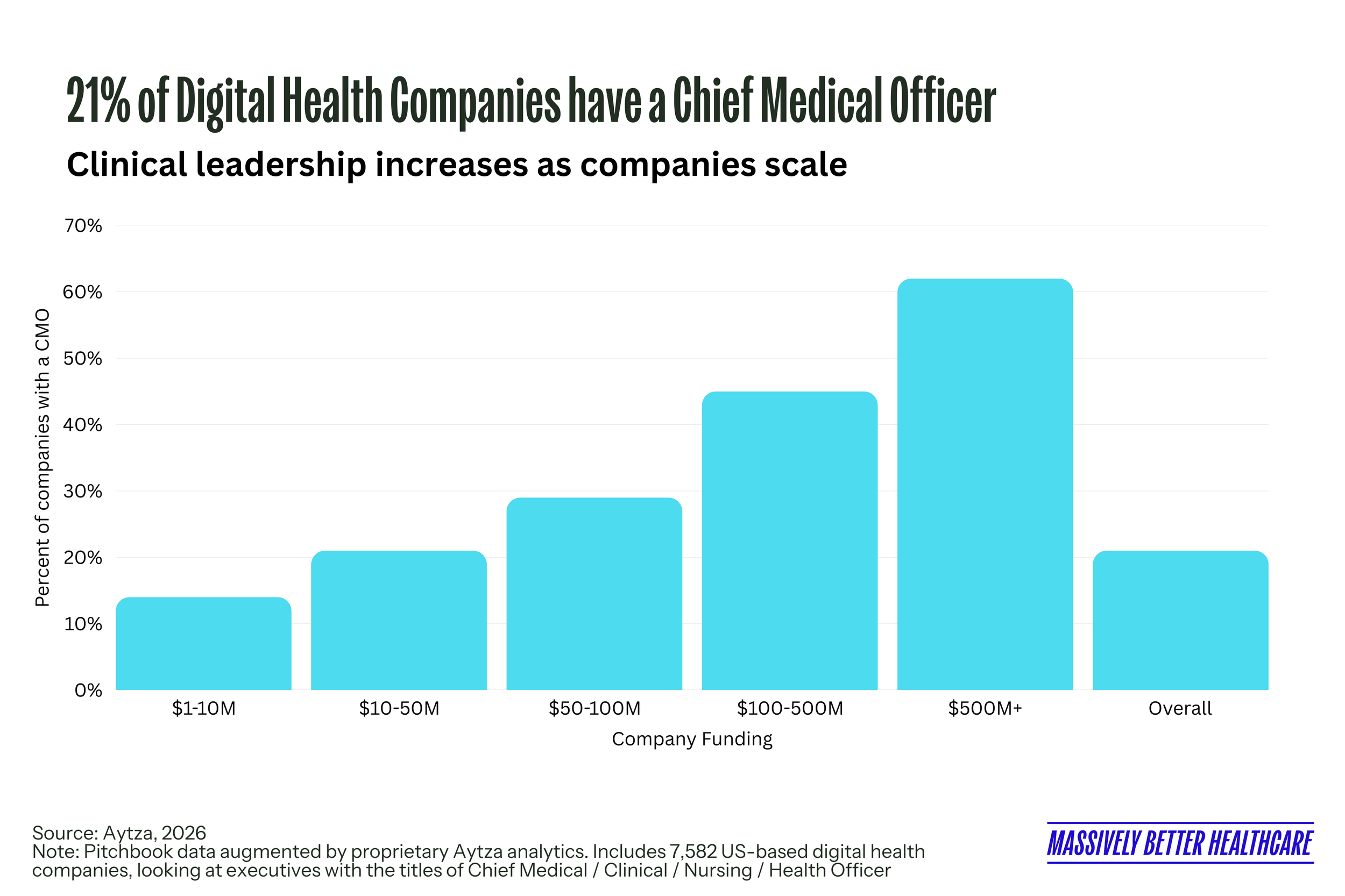
Today, 21% of U.S.-based digital health companies have executive clinical leadership, including a Chief Medical, Nursing, Clinical, or Health Officer. The share increases steadily with more funding: 14% of companies that have raised $1–10 million have a clinical leader, compared with 21% at $10–50 million and 29% at $50–100 million. Among companies that have raised $100–500 million, 45% have clinical leadership, rising to 62% for those that have raised more than $500 million. The data, from our friends at Aytza, suggest that formal clinical oversight becomes far more common as companies mature and operate at greater clinical, regulatory, and enterprise complexity.
What does a health tech CMO actually do?
Like everything in healthcare, the answer is "it depends." The CMO title says little about the job’s actual scope. CMOs have become a core executive role, but not a standardized one.
Neel Shah, MD, MPP, FACOG, CMO of Maven Clinic, uses a furry framework to explain different CMO paradigms:
Outside cats: Most CMOs focus externally on sales, marketing, and communications.
Inside cats: A smaller group deeply embedded in operations, product development, and care delivery.
Occasional roamers: The smallest contingent are inside cats trusted to venture outside and return home (like Dr. Shah himself).
To flesh out those feline archetypes a bit further, CMOs can provide value across various business areas from strategy to product to marketing.
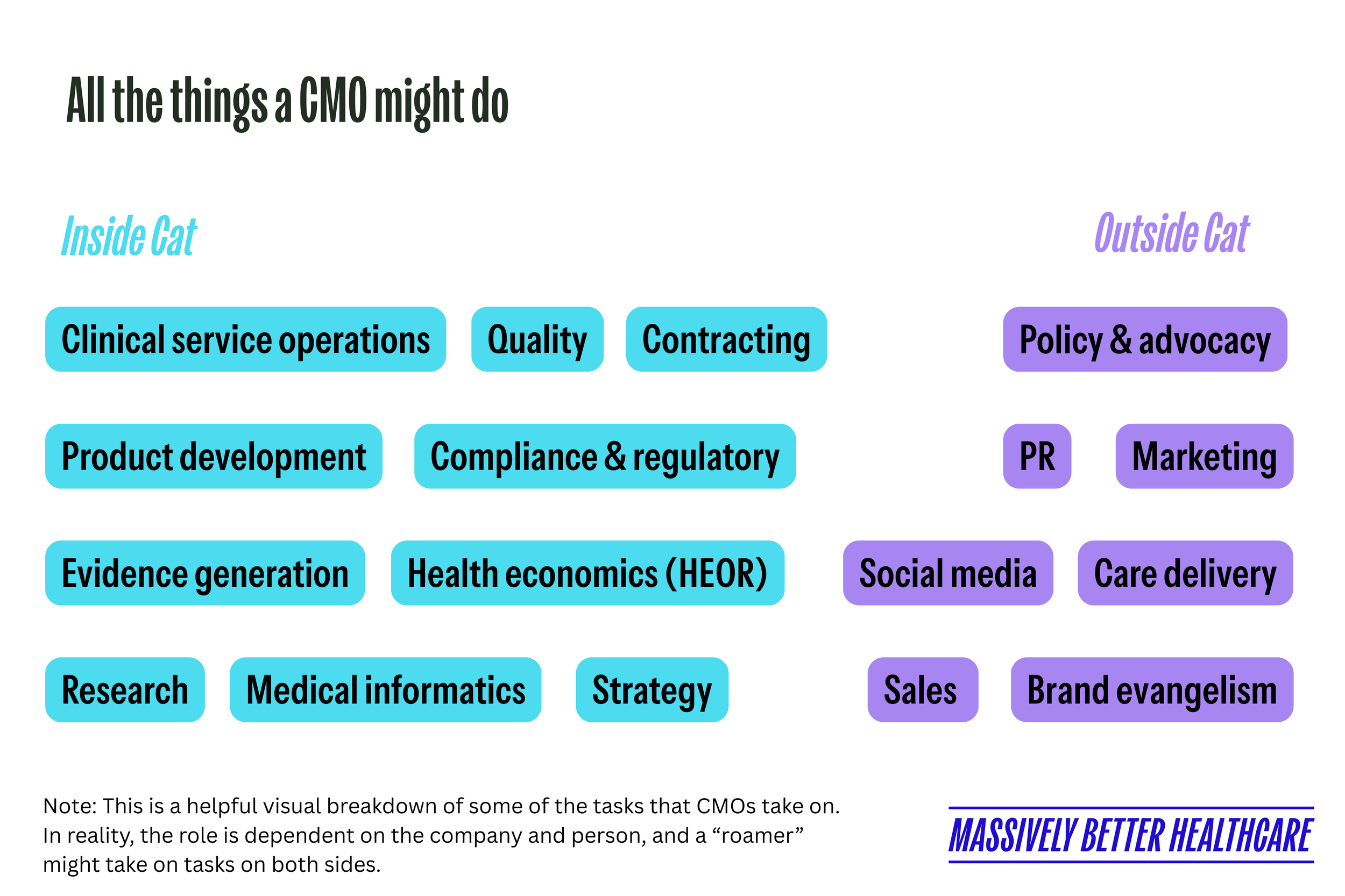
Given this breadth, Arianne Kidder, partner at Seae Ventures, calls a CMO who has all of these internal and external-facing capabilities "a bit of a unicorn." Alice Zheng, MD, MBA, MPH, partner at Foreground Capital, describes an ideal CMO as a "chameleon" who “can speak credibly in the clinical world, has respected experience, and is interested in innovation and disruption.” Those singular people exist, but they are rare.
When to hire a CMO (and when to hold off)
The good news? Founders don’t need to find a unicorn. As Dana Udall, PhD, Chief Clinical Officer at Nourish and former CCO at Headspace, shared, organizations need clarity on what they are solving for and the required seniority level. Should this person be a CMO, or would clinical advisors or a Medical Advisory Board (MAB) suffice? Consider this decision through multiple lenses: impact on product or service, compliance, and brand credibility. Staff to the business’s needs, not to hazy future hopes or market noise.
Sari Kaganoff, CEO of Aytza, recommends founders consider this decision within the context of the types of service(s) they are providing, which usually fall within three primary categories. Each category requires different CMO role hiring considerations and structure:
1. Care delivery (tech-enabled services)
While it’s common to rely on fractional clinical support early on, best practice for this type of organization is to have a CMO from day one. Financial conservativeness may be virtuous, but depending on services and context, delaying this hire can meaningfully lower the ceiling on growth from a strategy, product, sales, and scientific validation standpoint.
Byron Crowe, MD, MS, CMO at Doctronic, explains that by Series A, organizations need a CMO who can develop a coherent clinical strategy to drive product and technology forward. “Under-resourcing clinical leadership may feel like proper financial stewardship early on, but it can quickly become a bottleneck later,” he adds. Being slow to hire a CMO in a care delivery organization hinders the organization’s momentum as a whole. The CMO shifts from cost center to growth driver who can also play a significant role in supporting fundraising.
2. Care delivery adjacent (e.g provider tools, clinical documentation)
Organizations in this category offer services tightly coupled to care delivery. Depending on complexity and risk, they should have embedded clinical leadership from early on. Sari Kaganoff, CEO of Aytza, emphasizes that clinician leadership must be intertwined with the strategic and operational elements of the business to ensure clinical decisions reinforce and are reinforced by those other functions.
Less complex businesses can rely on fractional clinician leadership, advisors, or MABs. Alice Zheng, MD, MBA, MPH, partner at Foreground Capital, sees MABs as excellent for subject-matter expertise, developing protocols, creating algorithms, and staying close to emerging research. But she suggests that they shouldn’t take on a larger mandate, dictate clinical strategy, or serve in externally facing roles.
Aditi Mallick, MD, CMO at Hopscotch Primary Care, sees another benefit to MABs: sampling how different clinicians work with the organization to inform the scope and style of CMO that would best suit it. CMOs and MABs aren’t mutually exclusive, and Neel Shah, MD, MPP, FACOG, CMO at Maven Clinic, recommends that mature companies have both.
3. Broader digital health services (e.g., patient scheduling)
Companies in this category often rely on fractional CMOs, advisors, or MABs who step in when clinical judgment, credibility, or regulatory guidance is needed. That’s likely sufficient unless clinical complexity increases or the regulatory environment changes.
Companies in this category may come to call on their clinical support more frequently than expected, as healthcare complexity is constantly changing under new mandates. For example, patient scheduling software seems like a clear-cut SaaS product sold to healthcare providers and health systems. Unlike scheduling hair cuts and oil changes, healthcare scheduling has the added complexity of unique prior authorization requirements across different payers, varied test orders, and multi-provider coordination. Getting all of that right requires software that can manage numerous, complex rules and make adjustments in real-time. The stakes are high, as scheduling challenges can lead to excessive patient wait times, delays or abandonment of care, increased administrative costs, and scheduling gaps impacting provider or system margins.
Where to find CMO candidates
If you’ve determined your organization needs a CMO and defined the role’s scope, the next step is to find candidates. This can feel daunting for founders who lack strong clinical networks, prior clinical hiring experience, or the budget for an executive recruiter.
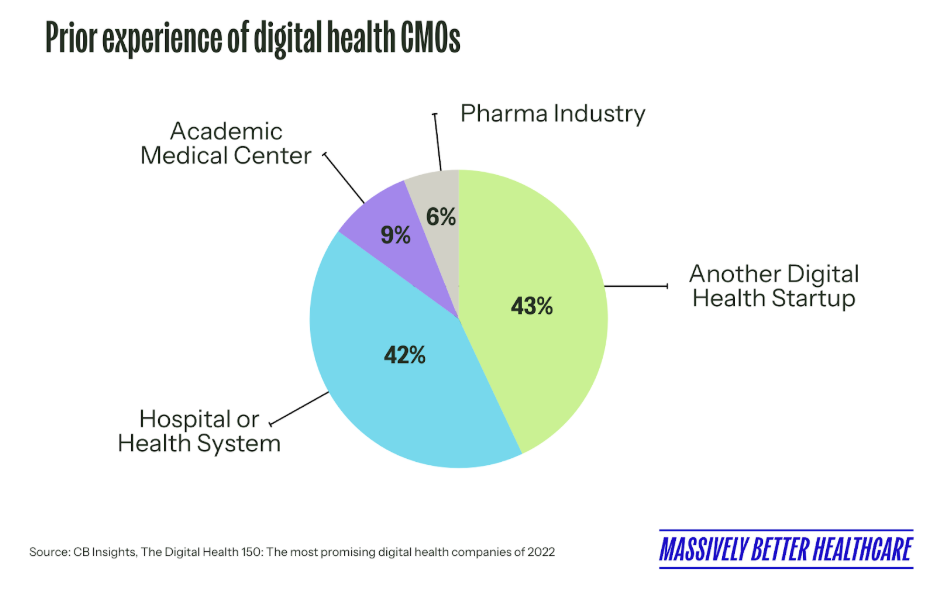
CB Insights’ 2022 analysis of the top 150 digital health companies found that 37% had CMOs previously employed across four areas, which remain directionally relevant years later.
Not all digital health businesses require MDs. Many successful organizations across care delivery and care-adjacent categories are better served by clinical leaders with non-MD licenses whose training is directly related to the product or service. Examples include nurse executives Brett Ives, NP, DrPH (Chief Clinical Officer at Altitude) and Jessica Horwitz, MSN, FNP-C (CCO and COO at Tia), plus therapist leaders Erin Parks, PhD (Co-Founder and CCO at Equip), Colleen Marshall, MA, LMFT (CCO at Two Chairs), and contributor Dana Udall, PhD (CCO at Nourish, formerly CCO at Headspace), to name a few.
Setting your CMO up for success
When asked about infrastructure or team dynamics that set the stage for CMO success, our contributors consistently responded with the same guidance, regardless of company type or stage:
The CMO should report directly to the CEO
The CMO must be given their own budget
The CMO must have autonomy
Aditi Mallick, MD, CMO at Hopscotch Primary Care, underscored the importance of the CMO controlling their own budget and team, framing it as the means to execute their mandate with required horsepower and credibility. While team size varies, especially at early organizations, if additional hiring isn’t possible, consider other ways to “staff” the CMO (dotted line reports, consultant budgets, etc).
CMOs must be part of core company decision-making, not just limited to care delivery and compliance. Alice Zheng, MD, MBA, MPH, partner at Foreground Capital, noted that the CMO "should be a strategic thinker and shape the future of the company." They shouldn’t be mere figureheads or sidelined to the clinical realm. Dana Udall, PhD, Chief Clinical Officer at Nourish and former CCO at Headspace, has experienced the magic of deep collaboration with other executives, co-creating a strategy for the company’s evolution.
It’s important that CMOs be given the latitude to contribute across domains:
Liz Kwo, MD, MBA, MPH, Chief Commercial Officer and former CMO at Everlywell: Focused on managing a team of 1099 independent contractor clinicians, clinical compliance, and new product development. Believes founders should hire “innovative CMOs that push boundaries in a startup more than focus on compliance.”
Geeta Nayyar, MD. MBA, CEO @ Kumar Konsulting and former CMO several times over: Prioritized business development, product development, and thought leadership. Finds it essential for CMOs to have approval power over the product.
Neel Shah, MD, MPP, FACOG, CMO at Maven Clinic: Concentrates on care model design and delivery, managing the clinician network, and owning clinical research and economics. The CMO should “lead a team that serves as the functional glue between product and growth.”
AI fluency is becoming table stakes for all executive hires, including CMOs. As Arianne Kidder points out, "AI workflow optimization should be the priority of the entire C-suite to be able to compete in this environment." With that said, CMOs are uniquely positioned to ensure that AI tools are aligned with evidence-based protocols, care pathways, and standards of practice, while also embedding ethical safeguards and patient safety guardrails into every aspect of its utilization. CMOs can also support the QA process and address relevant escalations.
Beyond technical alignment, Dana Udall, PhD, Chief Clinical Officer at Nourish and former CCO at Headspace, points out that CMOs are essential to clinical AI adoption across the organization. They translate AI strategy into clinical practice, anticipate workflow challenges, and ensure that new technologies actually improve care delivery. By building trust and alignment across the organization, CMOs enable responsible AI integration and foster a culture of continuous improvement.
How much do Chief Medical Officers at startups get paid?
J. Thelander Consulting provided us with real-time data insights on CMO compensation to help founders prepare cash and equity budgets (and CMOs better negotiate).
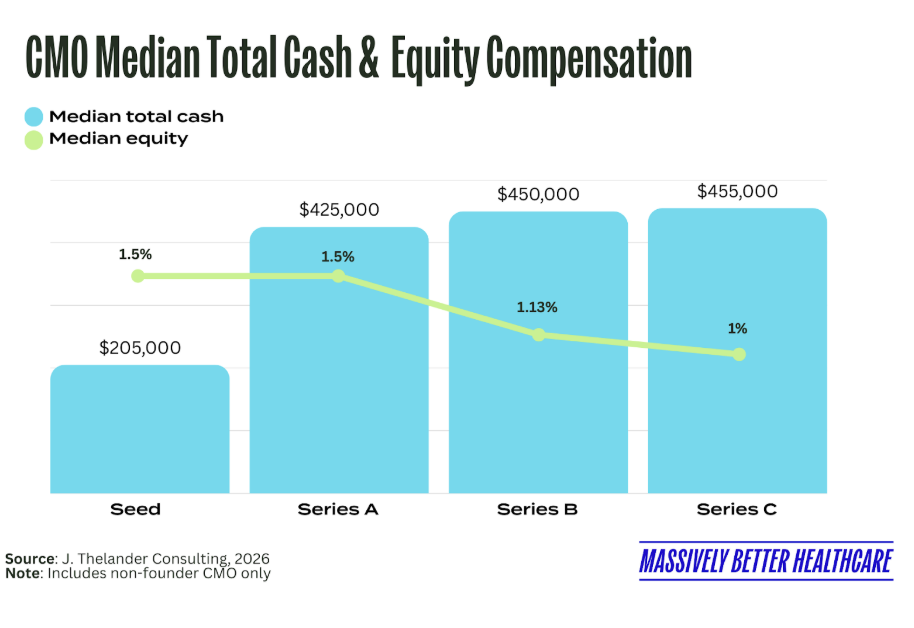
Key insights for compensation at the median:
Cash compensation for CMOs more than doubles from Seed to Series A ($205K → $425K)
From Series A through Series C, cash compensation plateaus around $450K
Equity decreases as companies mature to Series C (1.50% → 1.00%)
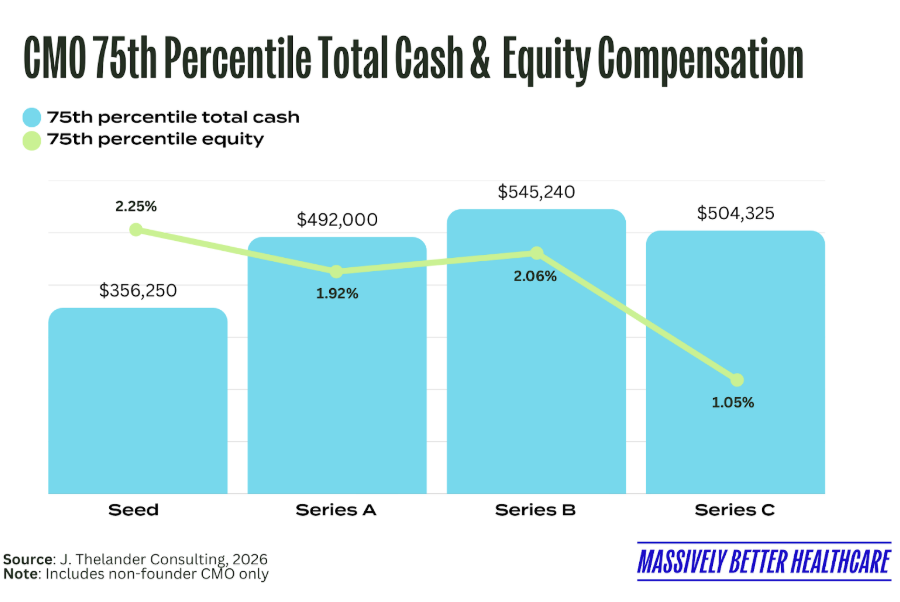
Key insights for compensation at the 75th percentile:
The biggest jump in cash compensation for CMOs is still Seed to Series A ($356K → $492K)
From Series B to Series C, cash compensation decreases 9% ($545K → $504K)
Equity starts higher (2.25%) but decreases to similar levels (1.05%) as companies mature to Series C
Armed with this data, founders and CMO candidates can work to make the CMO compensation structure more closely and appropriately mirror an equitable split.
Closing thoughts
The CMO hired at the right time, with the right scope, and the right degree of autonomy can accelerate growth, de-risk the business, and meaningfully shape the company’s future. As Geeta Nayyar, MD. MBA explained, “if done correctly, this is not a ‘check the box’ role but rather a key business executive on the team..[who] can accelerate growth and brand value.” Empower the CMO as a real partner, and the organization will reap the rewards.
Thank you to the clinicians, investors, and advisers who shared their time and knowledge with us:
Aditi Mallick, MD – CMO at Hopscotch Primary Care
Alice Zheng, MD, MBA, MPH – Partner @ Foreground Capital
Arianne Kidder – Partner @ Seae Ventures
Byron Crowe, MD, MS – CMO @ Doctronic
Dana Udall, PhD – CCO @ Nourish; former CCO @ Headspace
Geeta Nayyar, MD, MBA – CEO @ Kumar Konsulting; former CMO @ RadiantGraph, Jiro Health, Salesforce, and Greenway Health
Liz Kwo, MD, MBA, MPH – President @ Vanna Health; former CMO @ Everlywell
Sari Kaganoff – CEO @ Aytza; former Chief Commercial Officer @ Rock Health Advisory
We are also grateful to J. Thelander Consulting for providing unique data insights on CMO compensation. Anyone can access free, real-time compensation data for every job title they complete via participating in the Thelander Private Company Compensation Survey.