
How to Build a VC Target List
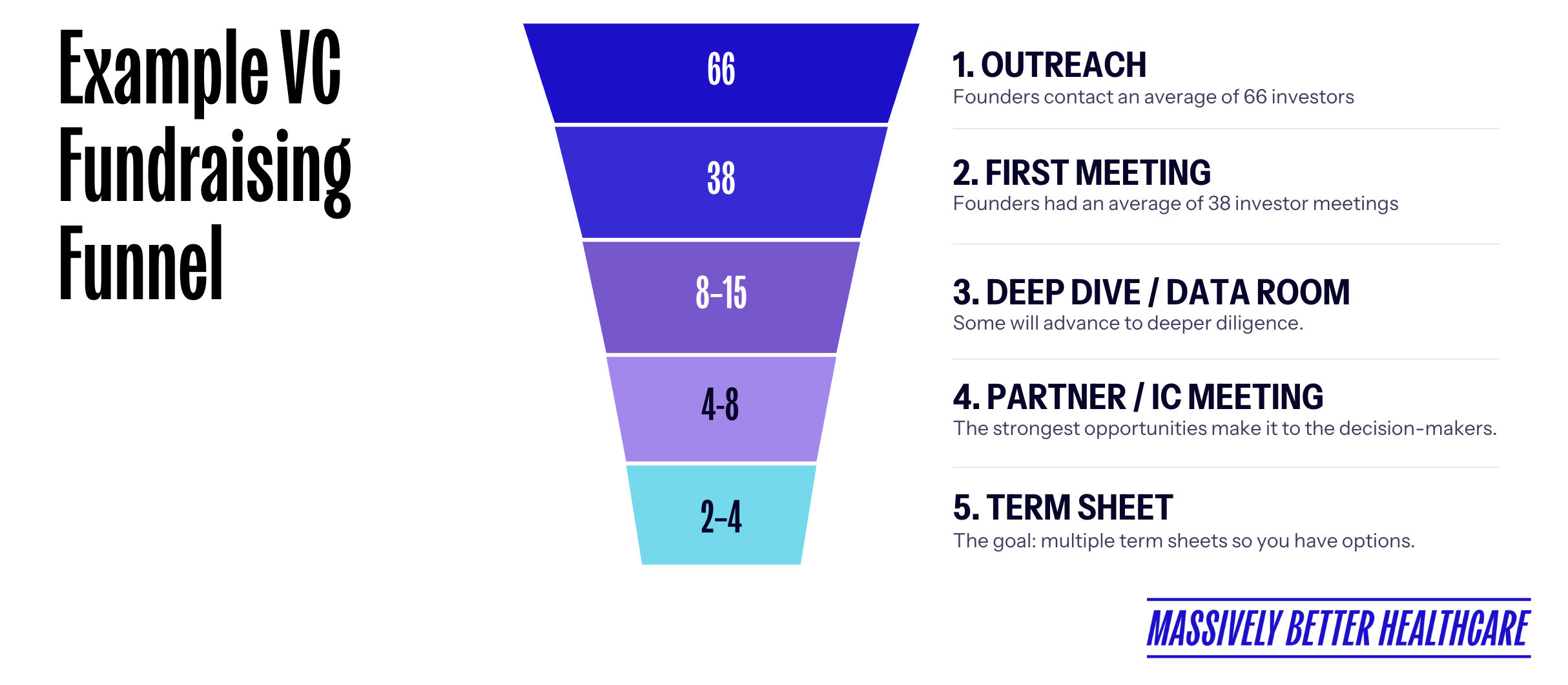
Raising venture capital is a numbers game. Startup fundraising data from Docsend found that, at the seed stage, the average founder contacted 66 investors and had 38 investor meetings.
But more outreach doesn’t necessarily mean more money. They also found only a weak correlation between the number of investors contacted and the number of meetings held, and an even weaker correlation between the number of investors contacted and the amount of seed funding raised. Reaching out to the right VCs matters more than simply reaching out to more VCs.
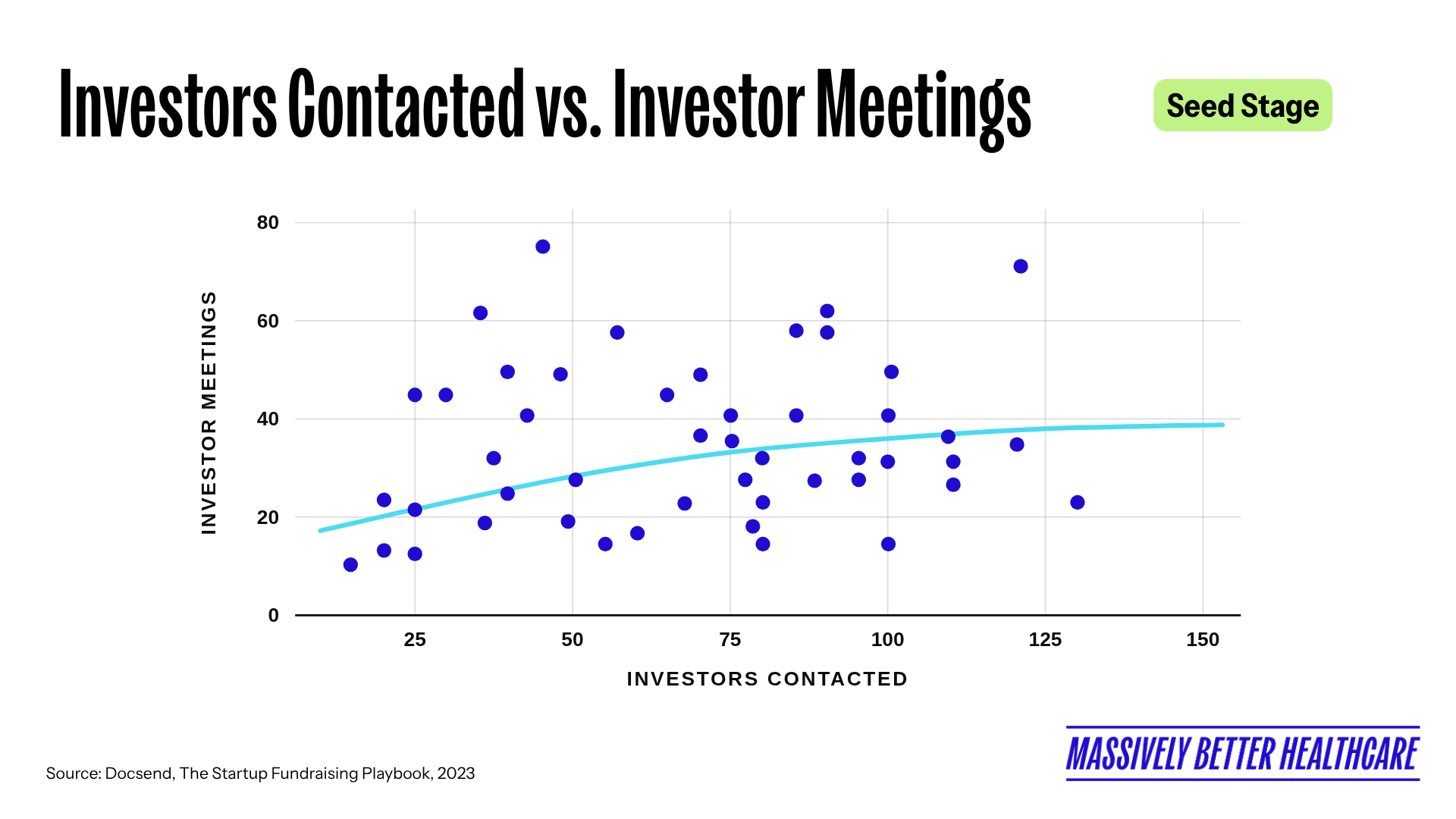
That’s why building a good target list matters. You need a large enough list to give yourself plenty of shots on goal, but a targeted enough list that those shots actually have a chance of going somewhere. The goal is twofold: to increase your chances of finding the right partner while avoiding time wasted on investors who were never a fit to begin with. In this piece, we’ll share our best practices for building that list and getting those investors to actually take the meeting.
Let’s jump right in.
The fundraising funnel in digital health
Fundraising is exhausting. Every hour spent chasing investors is an hour you're not spending building the product or supporting customers. So before you start, give investors as many reasons as possible to believe in the business. That means having real proof points:
Revenue or user growth
Clinical evidence
Signed contracts
Signs of product-market fit
Exceptional founder-market fit
Market tailwinds
Of course, you can't conjure up these proof points the week before a fundraise.
What you can control is how thoughtfully you build your investor list and how systematically you work through it. Finding the right partner can take dozens of conversations, and you can avoid conversations with investors that weren’t a fit to begin with.
In digital health, a typical meeting-to-check conversion rate for a seed-stage startup is under 5%. The funnel below illustrates how quickly a broad investor list can narrow as conversations progress toward signed checks.
How to build your VC target list
Start with a spreadsheet. You’ll need the names of the funds you want to pitch to, but just as importantly, the specific person at each fund who might actually champion your company. We suggest aiming for 100 vetted investors to start.
A few ways to find them:
Start with investors you know
Ask people in your network if they have suggestions
Check out our Digital Health Investor Database to filter firms by investor type, fund size, stage, and focus. For a shorter starting list, Halle also recently published her picks for digital health VCs.
Look at the investor lists of adjacent (but not competitive) startups that have raised in the last 12 months
Use AI to find additional investors based on a non-confidential description of your company. Just double-check with the firm’s website since AI makes stuff up.
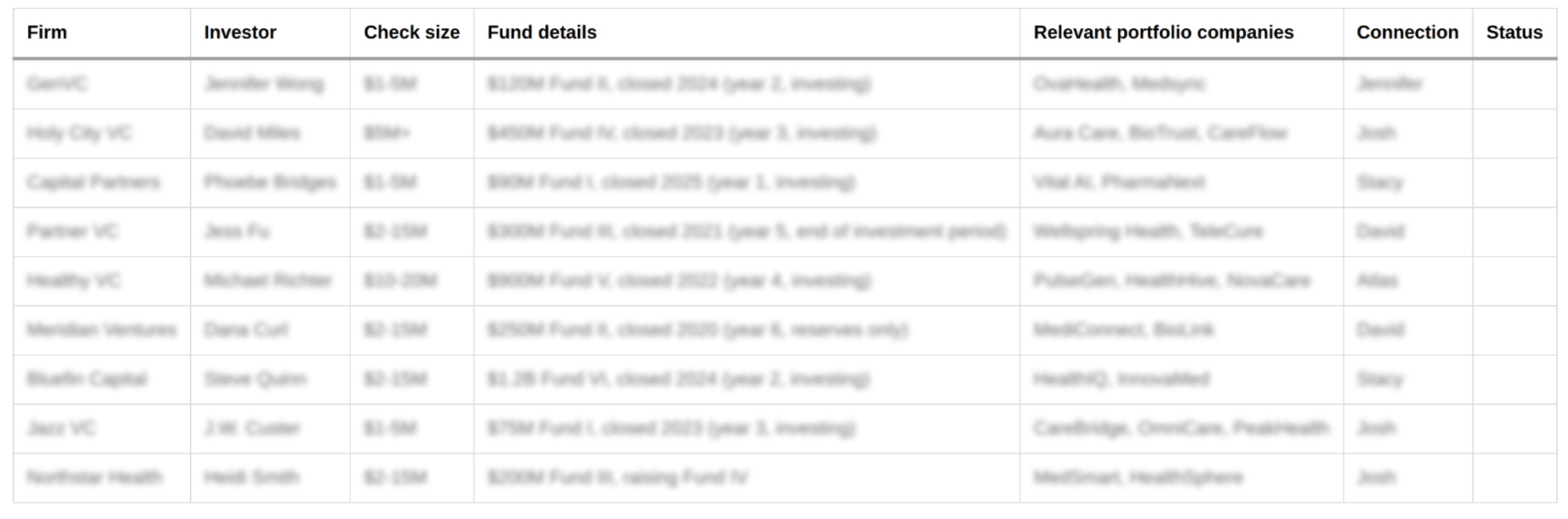
Your spreadsheet does not need to be complicated. At minimum, track the firm, the specific investor, typical check size, current fund, relevant portfolio companies, any connection you have, and where you are in the process. Here’s what that can look like:
How to narrow it down
Once you have the raw list, start narrowing it down to your priority targets.
Make sure they're still writing checks
You’ll want to make sure they're still writing checks and not a “zombie” fund. CB Insights counted ~3,500 active US investors in Q1 2026, down from 5,600 at the Q1 2022 peak. Before spending time on outreach, check whether the fund has made recent investments and is still deploying capital.
Find the right person at each firm
Once you have the right firms, find the right person at each one. Associates and principals can absolutely source deals and become strong internal advocates, so don’t ignore them. But your target list should name the partner who actually covers your sector and stage and can champion your company internally. Pick one partner per firm, or at most two, rather than reaching out to the entire team.
Check the fit on the firm's website
Then look at the fund website. Check its typical check size, stage, and any published investment thesis or “call for startups.” There's no need to pitch an investor that only does growth if you're raising a seed round. It's also helpful to note the fund size next to the check size. Fund size changes a lot of the dynamics… which we get into here.
Review their portfolio
While you’re on the firm’s website, check out their portfolio page as well. I generally skip investors who have backed a direct competitor, though there are certainly VCs who invest in competing companies (at least a dozen have backed Anthropic and OpenAI). An adjacent company is a much better signal as they already understand the space, have demonstrated interest in it, and you won't spend the first meeting explaining the category.
Map your connections
Last, fill in the connection column with anyone who can help make the intro. Warm intros almost always beat cold, and the time to figure out who can make that introduction is now, not after you have already sent the email.
Plan your timeline
Before you start working through the list, budget your calendar honestly. Carta estimates that the time from the first investor meeting to money in the bank typically takes three to six months. Start long before you need the money.
Your target list is a starting point
A good investor list should be broad enough to give you plenty of opportunities and targeted enough that every name has a reason to be there.
By the time you are finished, you should know:
Why each firm could be a fit
Who at the firm you want to reach
Whether they are actively investing
Whether they invest at your stage
Whether their check size makes sense
Which portfolio companies are relevant
Who might be able to introduce you
Then comes the next challenge: getting them to actually take the meeting.
In the next piece, we cover warm introductions, cold email, LinkedIn outreach, follow-ups, and how to give an investor a reason to reply.
