
How to Prepare for Your First VC Pitch
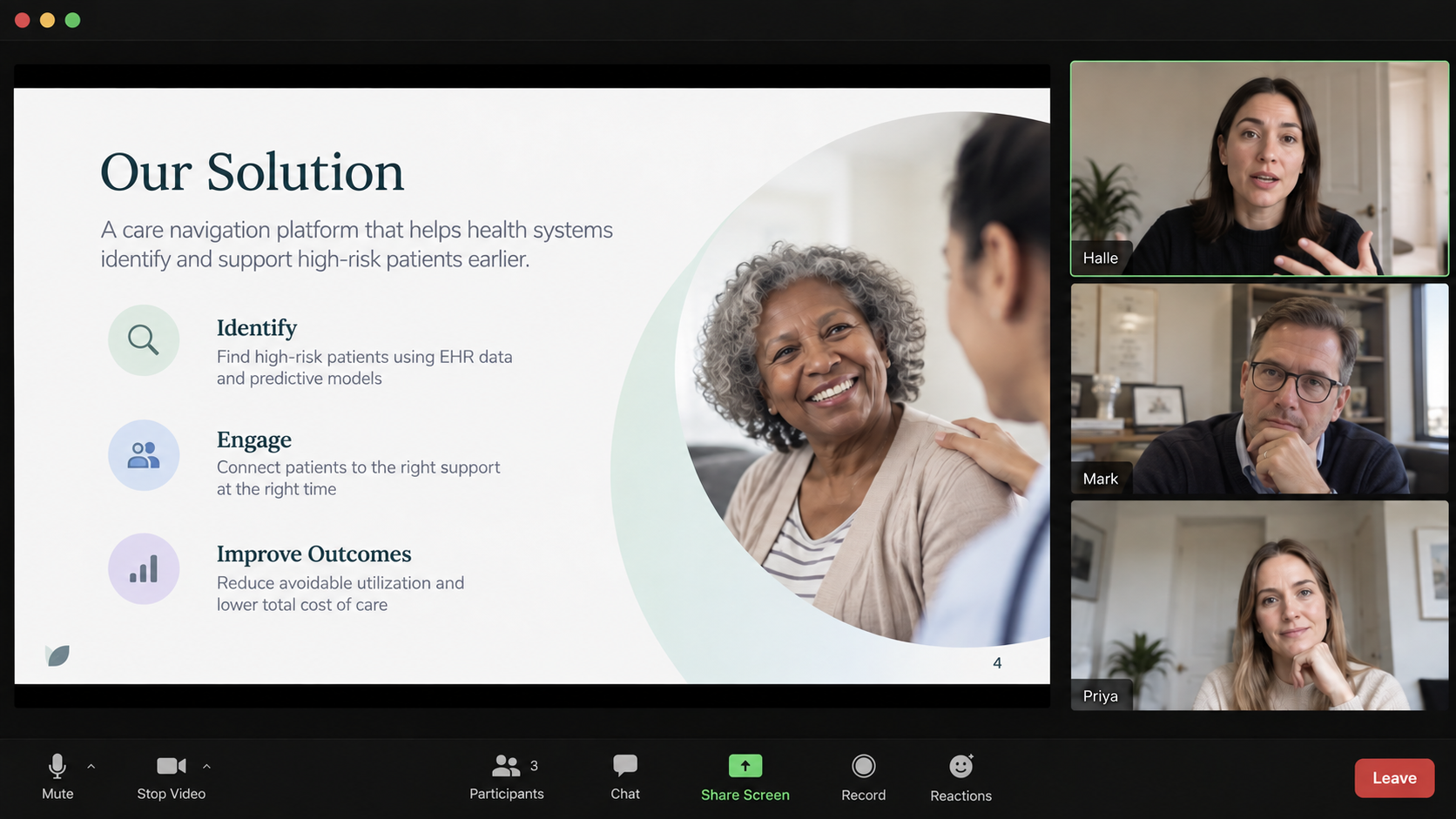
The best VC pitches feel more like conversations.
You may start on slide one, but within a few minutes, the investor may ask about your vision, jump ahead to unit economics, or drill into a customer you mentioned in passing. The conversation can move quickly, and the founders who handle it best are those who know the business well enough to follow it wherever it goes.
That means preparation goes well beyond memorizing your deck. You need to know the numbers behind it, be able to explain complicated parts of the business simply, and understand which questions you are likely to get at your stage.
In this piece, we’ll cover how to prepare for the meeting, the questions VCs are likely to ask, and what you should ask them in return.
Know your business cold
By the time you get to the meeting, you should already know why this particular investor is on your list. We covered that in How to Build a VC Target List. Now make sure you know the story behind your slides.
It goes without saying, but you should know your business inside and out. That includes your P&L, pipeline, pricing, unit economics, customers, market size, product roadmap, fundraising history, and the assumptions behind your forecasts. If a number appears in your deck, know where it came from and what is driving it.
There is no single perfect pitch deck, but most strong early-stage decks include:
Cover / tagline: Your company name and a single sentence explaining what you do.
Problem: The customer pain point and why existing solutions are not good enough.
Solution: Your value proposition and how the product solves that problem.
Product: What you have built today and, where relevant, what comes next.
Evidence: Any clinical, economic, or operational data that supports your claims, including outcomes, cost savings, ROI, validation studies, or early results from pilots.
Traction: Evidence that the market is responding, such as revenue, users, or early validation.
Market size: Who the customer is and how large the opportunity could become.
Competition: The alternatives customers have today and why you can win.
Business model: How you make money, including pricing and who pays.
Go-to-market: How you acquire customers and how that motion scales.
Team: Why this group of people is especially well suited to build the company.
The ask: How much you are raising and what milestones that capital should help you reach over the next 12 to 18 months.
The exact order can vary, especially once the conversation starts. What matters is that the deck tells a coherent story and gives the investor enough information to understand the business quickly.
CRV has a great founder guide on how to structure your pitch deck.
Expect the conversation to move around
You’ll notice that different investors get hung up on different details of your business. If they want to spend ten minutes on one customer, go there. If they jump from product to market size and back to the team, follow them. Then find a natural way back to the parts of the story they still need to hear.
Pay attention to where they linger. If three investors in a row get confused by your business model or challenge the same market assumption, that is useful information. The questions you hear in early meetings can make the pitch better for every meeting that follows.
Make complicated healthcare concepts easy to understand
Healthcare founders often have an extra job in the room: teaching enough healthcare for the investor to understand the business.
Your company may depend on reimbursement, risk adjustment, interoperability, a regulatory pathway, a clinical workflow, or some particularly wonky piece of health policy. You may have spent years immersed in it. The investor may be hearing about it for the first time, so make it easy for them!
Explain who pays whom. Show where the incentive sits. Walk through a concrete patient, provider, or customer example. Spell out what has to happen operationally for your product to get bought, implemented, and paid for. Use acronyms sparingly and define them when you do.
VCs have a hard time investing in businesses they do not understand. In healthcare, part of a great pitch is making a complicated system feel surprisingly simple.
VCs have a hard time investing in businesses they do not understand. In healthcare, part of a great pitch is making a complicated system feel surprisingly simple.
The questions VCs are likely to ask
The exact questions will depend on your stage. Halle breaks this down in How Investors Evaluate Digital Health Startups. At the pre-seed and seed stages, investors tend to spend more time on the team and the size of the opportunity. By Series A, there is much more evidence to evaluate. Later-stage conversations increasingly focus on unit economics, predictability, and scale.
Still, some version of the following questions comes up in almost every first meeting.
What are you building, and what problem does it solve?
You should be able to explain the company in plain English. Who has the problem? How painful is it? How do they solve it today? What changes when they use your product?
In healthcare, be precise about who uses the product, who decides to buy it, and who ultimately pays. Those may be three different people or organizations. Rock Health’s guide to building a coherent go-to-market strategy starts with the same basic questions: what value are you creating, for whom, and who should pay for it?
A useful test is whether someone unfamiliar with your corner of healthcare can explain the company back to you after hearing the pitch.
Why now?
Most healthcare problems have existed for decades. The interesting question is why this is the moment they can finally be solved.
Maybe the technology is finally ready. Maybe regulation or reimbursement changed. Maybe the cost structure became viable. Maybe a new distribution channel emerged, consumer behavior shifted, or infrastructure finally caught up with the idea.
Know what has been tried before and why it fell short. Investors will want to understand what changed in the world that gives this company a better chance of succeeding now. Founders who have tried, and failed, at similar solutions are surprisingly generous at giving tips, so reach out and ask them if they’d lend you their expertise.
Why you?
In the earliest stages, before there is enough company data to underwrite much else, investors will put the most emphasis on the team. They call this “betting on the jockey, not the horse”. And they are looking for founders who are smart, resilient, and hungry enough to build an enormous company.
In the earliest stages, before there is enough company data to underwrite much else, investors will put the most emphasis on the team. They call this “betting on the jockey, not the horse”. And they are looking for founders who are smart, resilient, and hungry enough to build an enormous company.
In a Stanford GSB study of 885 venture capitalists at 681 firms, 95% said the management team was an important factor in investment decisions and 47% said it was the most important.
Expect questions like:
Why did you choose this problem?
What keeps you up at night?
How did you meet your co-founder?
Have you worked together before?
What experience gives you an edge?
In healthcare, founder-market fit also means understanding the buyer, the workflow, the incentives, and how to actually drive adoption.
What have you proven so far?
Ideas are a dime a dozen, and AI has increasingly lowered the bar for starting companies. Evidence that you can execute is the best way to impress investors.
At seed, evidence may be early customers, usage, a clinical study, a growing waitlist, or signs that buyers are moving through the pipeline. By Series A, investors expect product-market fit, which is evidence that the business itself is working. That could be predictable revenue, improving unit economics, and customers who are absolutely obsessed with the product.
This is where it’s critical that you know the story behind the metrics. If revenue doubled, understand what drove the growth and how repeatable it is. If engagement looks strong, know what is sticky about your product. If you have a large pipeline, know the stages, sales cycle, historical conversion rate, and how much of it you reasonably expect to close.
Early-stage pitches are full of assumptions. It’s the investor’s job to decide if they agree with your assumptions or not.
How big can this get?
Investors are underwriting for outsized returns. Once you take VC money, the expectation is that the company has the potential to become large enough to support an acquisition or IPO that meaningfully returns capital to the fund.
That means market size matters a lot. Today, investors generally want to see a path to a market opportunity measured in the billions, and often tens of billions. Your initial product does not need to address all of that on day one, but you should be able to explain how the company grows into a very large opportunity over time.
Do not just drop a TAM from an industry report into your deck. Those estimates are often too broad to be useful. Show the bottoms-up math behind the opportunity instead.
For example, imagine you are selling hospital software:
Who could realistically buy the product? Say your initial customers are mid-sized hospitals in the U.S.
How many of those customers exist? If there are 1,000 hospitals that fit your target profile, that is your starting customer universe.
What could each customer reasonably pay? Let’s say the average annual contract is $250,000.
How much of that market can you plausibly reach? If you believe you could eventually serve 20% of those hospitals, that is 200 customers and $50 million in annual revenue.
Where can the company expand from there? You might move into larger health systems, add new product lines, sell into adjacent provider settings, or increase revenue per customer over time.
In this example, your current-product TAM is $250 million: 1,000 potential customers multiplied by a $250,000 annual contract. If you believe you could realistically win 20% of that market, your serviceable obtainable market would be about $50 million in annual revenue.
For most venture investors, that initial market would not be large enough on its own. The important question is what comes next. Can the company expand into larger customers, adjacent markets, new products, or additional revenue streams that take the opportunity from hundreds of millions to billions?
You should also be able to explain where that growth comes from. Are you taking share from an existing vendor, replacing an internal or manual process, expanding an existing category, or creating a new market altogether?
A good market-size slide should make the opportunity feel concrete. An investor should be able to follow the assumptions, pressure-test the math, and see a credible path from your initial wedge to a company large enough to matter at venture scale.
Who else is doing this, and why will you win?
Know your competition, including the alternatives that do not look like direct competitors.
Your customer may be choosing between you and another startup, but they may also be choosing Epic, an internal team, a spreadsheet, a call center, an existing vendor, or simply doing nothing. In healthcare, the status quo is often the hardest competitor to beat.
Be ready to explain (better yet, show) why customers choose your product or service. That could come down to better outcomes, lower cost, easier implementation, stronger workflow integration, proprietary data, distribution, or another advantage that matters to the buyer.
Then be ready for the inevitable question: “Why won’t XYZ just build this?” With XYZ generally being Epic, OpenAI, or whichever large incumbent already has the distribution.
A strong answer shows that you understand both your advantage and the incumbent’s incentives. Maybe the problem is too specialized to be a priority for them. Maybe solving it requires workflow depth, implementation expertise, proprietary data, or a business model they are unlikely to pursue. Or maybe pursuing the opportunity would require them to cannibalize an existing product or revenue stream. Be able to articulate a sound reason beyond “they are too big and slow.”
Avoid the competitive slide where every competitor gets three red Xs and you get five green checkmarks. Investors want to see that you understand the real choices your customer is making, why you win those choices today, and what could make that advantage durable.
Where are you in the fundraise?
Expect investors to ask where you are in the fundraising process. They are usually trying to understand how much momentum the round has and how quickly they may need to move.
Know how much you are raising (a range is fine), how much is already committed, and where you are in conversations with other investors. For example: “We’re raising $3 million to $4 million. We have $1 million committed and are in active conversations with several other firms.”
If you are just getting started, say that too. There is nothing wrong with being early in the process.
The first meaningful check is often the hardest one to get. Once one investor commits, especially one other VCs know and trust, it makes the rest of the round easier to close.
Healthcare founders can expect a few extra questions
Healthcare businesses have more moving parts than most. Depending on the company, expect investors to dig into questions such as:
Who uses the product, who buys it, and who ultimately pays?
Which budget does the money come from?
How long is the sales cycle, and who needs to sign off?
What does implementation require from the customer?
Does the product need to integrate with the EHR or another existing workflow?
What clinical evidence do you have today, and what will you eventually need?
How do reimbursement, regulation, or compliance affect the business?
What does ROI look like, and who captures that value?
What happens if Epic, another incumbent, or the customer decides to build something similar internally?
You may not have definitive answers to all of these questions yet, especially at pre-seed or seed. You should know which answers are based on evidence, which remain hypotheses, and what you need to learn next.
Ask the VC questions too
Try to leave time for your own questions. A first meeting is primarily about determining whether there is enough mutual interest to continue the conversation, so focus on questions that help you understand where you stand.
Good ones include:
What interested you about the company?
What would you need to believe to get more excited?
What does the process look like from here?
Is there anything specific you would want to see before the next conversation?
What check size do you usually write?
Do you lead, co-lead, or can you do either?
What is your ownership target?
I especially like asking what they would need to believe to get more excited. The answer often tells you exactly where the investment case feels weakest to them and sometimes surfaces a concern they wouldn’t have shared otherwise.
I especially like asking what they would need to believe to get more excited. The answer often tells you exactly where the investment case feels weakest to them and sometimes surfaces a concern they wouldn’t have shared otherwise.
Don’t go much further than those last three questions. There will be time for deeper diligence if the process continues. Questions about fund size, follow-on reserves, board seats, reference checks, and what happens if your partner leaves are covered in How to Choose the Right VC.
Leave knowing what happens next
Do not leave the meeting with a vague “we’ll be in touch.” Before you wrap, understand what happens next, who owns it, and roughly when you should expect to hear back.
If there is another meeting, find out who will be there and what they will want to cover. If the investor needs to discuss the company in a deal-flow or partnership meeting first, ask when that meeting happens and when it would make sense to follow up afterward.
Then send one concise follow-up email thanking them for the time, closing any open loops, and attaching whatever they requested, such as a data room. If something meaningful has changed since the meeting, such as a new customer, signed contract, or major milestone, include that too.
The bottom line
A good first meeting should leave the investor with a clear understanding of the company and confidence that you understand the business at a much deeper level than could ever fit into a deck.
Know your numbers. Make complicated healthcare concepts easy to grasp. Be comfortable letting the conversation move around, and pay attention to the questions that keep coming up because they will make your pitch better.
If there is mutual interest, the diligence should start going both ways. We cover how to evaluate the investor, the firm, and the fund in How to Choose the Right VC.
